Building a Local, Privacy‑First RAG Pipeline with LangChain: From Embeddings to Hybrid Retrieval
As part of my broader project to build a completely local, privacy‑first AI assistant, I’ve been exploring how to design a robust Retrieval‑Augmented Generation (RAG) pipeline using LangChain, LangGraph, and local LLMs. My goal is to create a model‑agnostic system that runs entirely on‑device, supports multimodal inputs, and uses a persistent vector store for fast, repeatable retrieval.
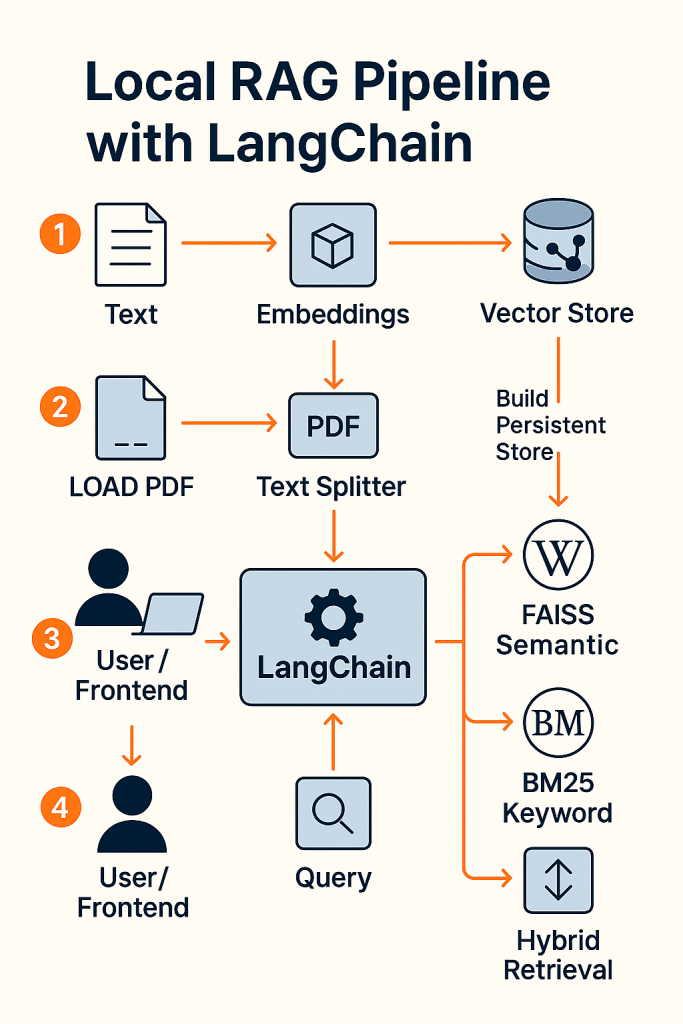
This notebook represents a major milestone in that journey. It walks through the full lifecycle of building a RAG system—from embedding text, to loading and chunking documents, to constructing a persistent FAISS vector store, to hybrid retrieval strategies that combine semantic and keyword search. The entire workflow is implemented using local models (Qwen embeddings) and open‑source components.
All code for this workflow is available in the public GitHub repository. I encourage you to clone it, run the notebook end‑to‑end, and contribute improvements or extensions.
github repo
The full notebook with all the steps, is available here:
RAG-techniques-LangChain
Clone the repo, open the Jupyter notebook, and step through the code.
Notebook Step by Step Walkthrough
Text Embedding with Qwen Model
This cell demonstrates how to use the Qwen3-Embedding model for text embeddings through LangChain’s HuggingFace integration.
Setup
We initialize a text embedder using the Qwen/Qwen3-Embedding-0.6B model, which is a compact 0.6 billion parameter embedding model. This embedder will convert text into dense vector representations that can be used for:
- Semantic search
- Text similarity comparison
- Document retrieval
- Clustering and classification tasks
The HuggingFaceEmbeddings class provides a simple interface to load and use the model with default configurations.
from langchain_huggingface import HuggingFaceEmbeddings
import torch
text_embedder = HuggingFaceEmbeddings(
    model_name="Qwen/Qwen3-Embedding-0.6B"
    )
d:\Code\LangChain-RAG\.venv\Lib\site-packages\langchain_core\_api\deprecation.py:26: UserWarning: Core Pydantic V1 functionality isn't compatible with Python 3.14 or greater.
  from pydantic.v1.fields import FieldInfo as FieldInfoV1
d:\Code\LangChain-RAG\.venv\Lib\site-packages\tqdm\auto.py:21: TqdmWarning: IProgress not found. Please update jupyter and ipywidgets. See https://ipywidgets.readthedocs.io/en/stable/user_install.html
  from .autonotebook import tqdm as notebook_tqdm
Text Embedding Generation
In the cell below, we define a list of sample texts and generate embeddings for them:
Sample Texts: We create a list of 4 sentences covering two semantic topics:
- Weather-related sentences (about sunny days)
- Food-related sentences (about pizza)
Embedding Generation: We use the
embed_documents()method of our text embedder to convert all texts into vector representations simultaneously.Output: The code prints each embedding vector and displays:
- The total number of embeddings generated (should be 4, one per text)
- The embedding dimension (1024 for the Qwen3-Embedding-0.6B model)
Expected Result: Semantically similar texts (e.g., the two weather sentences or the two pizza sentences) should have embeddings that are closer together in the vector space, which can be useful for similarity comparison and clustering tasks.
texts = [
    "The sky is clear and the sun is shining brightly",
    "It is a sunny day with no clouds in sight.",
    "I am craving a slice of pizza for dinner tonight.",
    "I feel like eating pizza this evening."
]

embeddings = text_embedder.embed_documents(texts)

for i, embedding in enumerate(embeddings):
    print(f"Text {i+1} embedding: {embedding}")

print(f"Total embeddings generated: {len(embeddings)}")
print(f"Embedding dimension: {len(embeddings[0])}")
Text 1 embedding: [-0.013901935890316963, -0.016430605202913284, -0.002654974116012454, 0.01667698659002781, ...]
Text 2 embedding: [-0.0180942602455616, -0.020602528005838394, -0.003632498439401388, -0.016885682940483093, ...]
Text 3 embedding: [-0.025657763704657555, 0.024037810042500496, -0.002704175654798746, -0.022849055007100105, ...]
Text 4 embedding: [-0.02188185043632984, 0.03758257254958153, -0.0023960028775036335, -0.019942952319979668, ...]
Total embeddings generated: 4
Embedding dimension: 1024
PDF Document Loading
In the cell below, we load a PDF document using LangChain’s PyPDFLoader:
PDF Loader Initialization: We create a
PyPDFLoaderinstance pointing to a PDF file about General Astronomy from Wikibooks located atbooks/general-astronomy-wikibooks.pdf.Document Loading: The
load()method extracts all pages from the PDF and converts them into a list ofDocumentobjects. EachDocumentcontains:page_content: The text content extracted from that pagemetadata: Information about the page including producer, page number, and page label
Output: The code displays:
- The total number of pages loaded from the PDF
- The complete text content of the first page (index 0)
- The metadata of the first page (including PDF producer info, page number, etc.)
- The text content of the 100th page (index 99) to demonstrate access to later pages
Expected Result: This will show how PDF documents are structured in LangChain, with each page becoming a separate document that can be processed, embedded, or used for retrieval tasks. The astronomy textbook should contain several hundred pages of content about astronomical topics.
from langchain_community.document_loaders.pdf import PyPDFLoader

pdf_loader = PyPDFLoader("books/general-astronomy-wikibooks.pdf")
document = pdf_loader.load()

print(f"Total pages loaded: {len(document)}\n\n")
print(f"Content of first page:\n{document[0].page_content}\n\n")
print(f"Metadata of first page:\n{document[0].metadata}\n\n")

print(f"Content of the 100th page:\n{document[99].page_content}\n\n")
d:\Code\LangChain-RAG\.venv\Lib\site-packages\langchain_core\_api\deprecation.py:26: UserWarning: Core Pydantic V1 functionality isn't compatible with Python 3.14 or greater.
  from pydantic.v1.fields import FieldInfo as FieldInfoV1
d:\Code\LangChain-RAG\.venv\Lib\site-packages\tqdm\auto.py:21: TqdmWarning: IProgress not found. Please update jupyter and ipywidgets. See https://ipywidgets.readthedocs.io/en/stable/user_install.html
  from .autonotebook import tqdm as notebook_tqdm
Total pages loaded: 341


Content of first page:
General Astronomy
en.wikibooks.org


Metadata of first page:
{'producer': '3-Heights™ PDF Optimization Shell 6.3.1.5 (http://www.pdf-tools.com)', 'creator': 'LaTeX with hyperref package', 'creationdate': '2015-03-15T13:10:03+01:00', 'moddate': '2023-10-09T20:27:12+00:00', 'source': 'books/general-astronomy-wikibooks.pdf', 'total_pages': 341, 'page': 0, 'page_label': 'I'}


Content of the 100th page:
Motion and Gravity
and the first to imagine an underlying order in nature — though no real connection between
human and celestial events existed, the prophecies of astrology were the ancestors of modern
scientific prediction.
The early astronomers understood a great deal about the world around them. By Aristotle’s
time, many people believed that the world was round. They knew this from several sources
of evidence:
1. When ships sailed beyond the horizon, those watching from land would see the hull
disappear first, and then would watch the sail disappear. Sailors see the land sink
below the horizon bottom-first. From this, they gathered that the surface of the world
was curved, and that the ship was moving around the curvature of the Earth.
2. Ancient people supposed eclipses of the Moon to be the shadow of the Earth. Shadows
seen during lunar eclipses were always round. The only shape that always casts a
round shadow is a sphere. This suggested that the Earth was spherical.
3. Travelers noticed that new stars became visible as they moved in their journeys. When
travelers move north, the North Star and the northern constellations gain altitude in
the sky. The ancients recognized that this implied that the Earth is curved.
Aristotle mentions in his writings that some thinkers of his time hold that the Earth is flat,
while others believe it to be spherical. He himself argues firmly that the Earth is a sphere.
After Aristotle’s time, nearly all Western writers claim that the Earth is a sphere.
92
Document Chunking with Text Splitter
In the cell below, we split the loaded PDF document into smaller, manageable chunks using LangChain’s CharacterTextSplitter:
Text Splitter Configuration: We initialize a
CharacterTextSplitterwith specific parameters:separator = "\n": Splits text at newline characters to preserve natural paragraph boundarieschunk_size = 1000: Each chunk will contain approximately 1000 characterschunk_overlap = 100: Adjacent chunks will overlap by 100 characters to maintain context continuity across boundaries
Document Splitting: The
split_documents()method processes all pages from the loaded PDF document and breaks them into smaller chunks based on the configured parameters.Output: The code displays:
- The total number of chunks created from the entire PDF
- The content of the 50th chunk (index 49)
- The content of the 51st chunk (index 50) to demonstrate the overlap between consecutive chunks
Why Chunking?: Breaking documents into smaller chunks is essential for:
- Embedding Generation: Most embedding models have token limits and work better with shorter text segments
- Semantic Search: Smaller chunks allow more precise retrieval of relevant information
- Context Management: Chunks can fit within the context window of language models for question-answering tasks
- Memory Efficiency: Processing smaller pieces reduces computational requirements
Chunk Overlap: The 100-character overlap ensures that information spanning chunk boundaries isn’t lost and maintains semantic continuity between adjacent chunks.
from langchain_text_splitters import CharacterTextSplitter

text_splitter = CharacterTextSplitter(
    separator = "\n",
    chunk_size = 1000,
    chunk_overlap = 100
)

chunks = text_splitter.split_documents(document)

print(f"Total chunks created: {len(chunks)}\n\n")
print(f"Content of the 50th chunk:\n{chunks[49].page_content}\n\n")
print(f"Content of the 51st chunk:\n{chunks[50].page_content}\n\n")
Total chunks created: 876


Content of the 50th chunk:
the Virgo Cluster. It orbits near the edge of the Cluster, so we can see much of its center
in a small region of the sky in the direction of the constellation Virgo. Presently, the Milky
Way is moving away from the center of Virgo Cluster. In the distant future, however, the
Cluster’s pull will slow the Milky Way and draw it inward.
Although our reach now includes many more objects, the size scale of galaxy clusters still
does not represent an expansion over the last size scale by a factor of 1000. We have not
fully reached the next step in our journey until we come to the scale of hundreds of millions
of light years. At this scale, even the galaxy clusters form clusters. These groups of galaxy
clusters are called superclusters . A supercluster may contain hundreds of thousands of
galaxies. The Virgo Cluster is a member of a supercluster called the Virgo Supercluster.
Light from the edge of our 500 million light-year reach has traveled for 500 million years


Content of the 51st chunk:
Light from the edge of our 500 million light-year reach has traveled for 500 million years
before reaching us. This means that we see the Virgo Supercluster as it was 500 million
years ago. Five hundred million years can be a long time, but it isn’t really long enough
for the universe to have changed significantly. Even though the light is old, the universe at
the edge of the Virgo Supercluster still looks much like the universe nearby.
8
Recursive Character Text Splitter
In the cell below, we demonstrate an alternative and more sophisticated approach to document chunking using LangChain’s RecursiveCharacterTextSplitter:
Hierarchical Splitting Strategy: Unlike the simple
CharacterTextSplitterused earlier, theRecursiveCharacterTextSplitteruses a hierarchical list of separators:"\n\n": First tries to split on double newlines (paragraph breaks)"\n": If chunks are still too large, splits on single newlines" ": If still too large, splits on spaces (word boundaries)"": As a last resort, splits on individual characters
Smart Splitting Logic: The splitter recursively attempts each separator in order, using the first one that produces chunks within the desired size. This preserves document structure better than a single-separator approach.
Configuration Parameters:
chunk_size = 1000: Target size of 1000 characters per chunkchunk_overlap = 100: 100-character overlap between adjacent chunks for context continuity
Document Processing: The same PDF document is re-split using this more intelligent strategy, which should produce chunks that respect natural text boundaries more effectively.
Output Comparison: The code displays:
- Total number of chunks created (may differ from the
CharacterTextSplitterresult) - Content of the 50th and 51st chunks for comparison with the previous splitting method
- Total number of chunks created (may differ from the
Advantages of Recursive Splitting: This approach produces more semantically coherent chunks by:
- Preserving paragraph boundaries when possible
- Avoiding mid-sentence splits in most cases
- Maintaining better context within each chunk
- Improving the quality of embeddings and retrieval results
This is generally the preferred method for splitting documents in production RAG (Retrieval-Augmented Generation) systems.
from langchain_text_splitters import RecursiveCharacterTextSplitter

text_splitter = RecursiveCharacterTextSplitter(
    separators = ["\n\n", "\n", " ", ""],
    chunk_size = 1000,
    chunk_overlap = 100
)

chunks = text_splitter.split_documents(document)
print(f"Total chunks created: {len(chunks)}\n\n")
print(f"Content of the 50th chunk:\n{chunks[49].page_content}\n\n")
print(f"Content of the 51st chunk:\n{chunks[50].page_content}\n\n")
Total chunks created: 877


Content of the 50th chunk:
the Virgo Cluster. It orbits near the edge of the Cluster, so we can see much of its center
in a small region of the sky in the direction of the constellation Virgo. Presently, the Milky
Way is moving away from the center of Virgo Cluster. In the distant future, however, the
Cluster’s pull will slow the Milky Way and draw it inward.
Although our reach now includes many more objects, the size scale of galaxy clusters still
does not represent an expansion over the last size scale by a factor of 1000. We have not
fully reached the next step in our journey until we come to the scale of hundreds of millions
of light years. At this scale, even the galaxy clusters form clusters. These groups of galaxy
clusters are called superclusters . A supercluster may contain hundreds of thousands of
galaxies. The Virgo Cluster is a member of a supercluster called the Virgo Supercluster.
Light from the edge of our 500 million light-year reach has traveled for 500 million years


Content of the 51st chunk:
Light from the edge of our 500 million light-year reach has traveled for 500 million years
before reaching us. This means that we see the Virgo Supercluster as it was 500 million
years ago. Five hundred million years can be a long time, but it isn’t really long enough
for the universe to have changed significantly. Even though the light is old, the universe at
the edge of the Virgo Supercluster still looks much like the universe nearby.
8
Semantic Chunking
In the cell below, we demonstrate an advanced, intelligent approach to document chunking using LangChain’s SemanticChunker:
Semantic-Based Splitting: Unlike character-based or recursive text splitters that rely on fixed separators and character counts, the
SemanticChunkeruses embeddings to understand the semantic meaning of the text and splits documents based on semantic similarity between sentences.How It Works:
- The splitter generates embeddings for consecutive sentences in the document
- It calculates semantic similarity between adjacent sentences
- When the similarity drops below a threshold (indicating a topic shift), it creates a new chunk
- This ensures each chunk contains semantically coherent content about a single topic
Embedding Model: Uses the Qwen/Qwen3-Embedding-4B model, a larger and more powerful 4 billion parameter embedding model (compared to the 0.6B model used earlier), which provides:
- Higher quality semantic representations
- Better understanding of context and meaning
- More accurate detection of topic boundaries
Configuration Parameters:
embeddings = embedding_model: The HuggingFace embedding model to use for semantic analysisbuffer_size = 1: Number of sentences to consider when calculating semantic breaks (1 means comparing consecutive sentences)add_start_index = True: Adds metadata tracking the starting character position of each chunk in the original document
Document Processing: The same astronomy PDF document is split using semantic understanding rather than fixed rules.
Advantages of Semantic Chunking: This approach produces the highest quality chunks by:
- Respecting Topic Boundaries: Splits occur naturally where topics change, not at arbitrary character counts
- Maintaining Semantic Coherence: Each chunk discusses a single coherent topic or concept
- Variable Chunk Sizes: Chunks can be longer or shorter based on natural content boundaries
- Improved Retrieval Quality: Better semantic coherence leads to more accurate search and retrieval results
Trade-offs:
- Computational Cost: Requires generating embeddings for the entire document, which is more resource-intensive
- Processing Time: Slower than character-based splitting methods
- Dependencies: Requires a good embedding model and sufficient compute resources
This method is ideal for production RAG systems where retrieval quality is paramount and computational resources are available.
from langchain_experimental.text_splitter import SemanticChunker
from langchain_huggingface import HuggingFaceEmbeddings
import torch

embedding_model = HuggingFaceEmbeddings(
    model_name = "Qwen/Qwen3-Embedding-4B"
)

text_splitter = SemanticChunker(
    embeddings = embedding_model,
    buffer_size = 1,
    add_start_index = True
)

chunks = text_splitter.split_documents(document)
Loading checkpoint shards: 100%|██████████| 2/2 [00:01<00:00, 1.09it/s]
print(f"Total chunks created: {len(chunks)}\n\n")
print(f"Content of the 500th chunk:\n{chunks[499].page_content}\n\n")
print(f"Content of the 501st chunk:\n{chunks[500].page_content}\n\n")
Total chunks created: 1092


Content of the 500th chunk:
This
means that the Earth makes a little more than a full rotation over the course of a solar day. A sidereal day is the amount of time it takes for the stars to go once around the sky, equal
to 23 hours and 56 minutes. The word sidereal means ”relating to the stars.” The difference
in length between the solar and sidereal day causes the rising and setting times of stars to
change throughout the year. If the star Rigel, for example, rises at noon today, it will rise
at 11:56 tomorrow. In six months, it will rise at midnight. Because the difference between
solar days is tied to the orbit of the Earth, there is exactly one more sidereal day in a year
than there are solar days. 57


Content of the 501st chunk:
Observational Astronomy
Figure 30
A sidereal month is the period of the moon in relation to the stars; approximately 27
(1/3) days (13 degrees a day). Ancient peoples used this period to track time, as evidenced
by the Big Horn Medicine Wheel in Sheridan, Wyoming.
FAISS Vector Store Creation and Semantic Search
In the cell below, we create a vector database using FAISS (Facebook AI Similarity Search) and perform semantic search on our astronomy document:
Embedding Model Initialization: We create a new instance of
HuggingFaceEmbeddingsusing the Qwen/Qwen3-Embedding-0.6B model (the smaller, faster embedding model) for generating vector representations of our document chunks.Vector Store Creation: We use
FAISS.from_documents()to:- Take all the semantically-chunked documents from the previous step
- Generate embeddings for each chunk using the embedding model
- Build a FAISS index that enables fast similarity search across all chunks
- Store the entire vector database structure in memory
Persistent Storage: The
save_local("faiss_index")method saves the vector store to disk in a directory called “faiss_index”, allowing us to reload it later without re-processing the entire document.Semantic Search Setup: We convert the vector store into a retriever with:
search_kwargs={"k": 5}: Configured to return the top 5 most relevant chunks for any query
Query Execution: We perform a semantic search with the question “What is the distance from the Earth to the Sun?”:
- The query is converted into an embedding
- FAISS finds the 5 document chunks with embeddings most similar to the query
- Results are ranked by semantic similarity
Results Display: The code prints all 5 retrieved chunks, showing the content that the system determined to be most relevant to answering the distance question.
GPU Memory Management: After processing, the code clears CUDA memory if a GPU was used, freeing resources for subsequent operations.
How FAISS Works: FAISS uses efficient algorithms to quickly search through millions of high-dimensional vectors, making it ideal for retrieval-augmented generation (RAG) systems where we need to find relevant context from large document collections.
from langchain_community.vectorstores import FAISS
from langchain_huggingface import HuggingFaceEmbeddings
import torch


embedding_model = HuggingFaceEmbeddings(
    model_name = "Qwen/Qwen3-Embedding-0.6B"
)

vector_store = FAISS.from_documents(
    documents = chunks,
    embedding = embedding_model
)

vector_store.save_local("faiss_index")

query = "What is the distance from the Earth to the Sun?"
vector_retriever = vector_store.as_retriever(search_kwargs={"k":5})
results = vector_retriever.invoke(query)

print(f"Top 5 results for the query '{query}':\n\n")
for i, result in enumerate(results):
    print(f"Result {i+1} content:\n{result.page_content}\n\n")

#clear gpu memory
if torch.cuda.is_available():
    torch.cuda.empty_cache()
Top 5 results for the query 'What is the distance from the Earth to the Sun?':


Result 1 content:
Sun at distances between approximately 0.3 and 1.5 Astronomical Units from the Sun (an
Astronomical Unit or AU is defined as the average distance between the Earth and the Sun,
so the Earth is 1 A. U. from the Sun). In contrast, the Jovian planets spread from 5AU to
30 AU. The terrestrials are fairly small; the Earth is the largest of the four, and Mercury
is only about 1/4 the diameter of the Earth. The Jovians are relatively large, from 4 to 11
times the size of the Earth.
All of the terrestrial planets are presumed to have formed through the same process, so
all should share common properties. The terrestrial planets are different than the Jovians
because a planet close to a star forms under different conditions than if it is far from the
star. The terrestrial planets formed separately in different orbits, so there are significant
differences between the four. The four terrestrials have many things in common, but each


Result 2 content:
second. This distance, the distance light travels in one second, is called a light-second .
Figure 3 This mosaic image of the Sun and six planets was taken by the Voyager
spacecraft from beyond the planets. Earth is barely visible as a blue dot in one of the
frames, almost lost in the glare from sunlight. The Voyager spacecraft, which view the
orbits of the planets from outside, are the most distant man-made objects from Earth.
Notice that the two terrestrial planets, Venus and Earth, are much nearer the Sun than
the others.
Another step out will give us reach to most of the planets. We now encompass the bulk of
the Solar System , the system comprising the Sun and all of the objects orbiting around
it. This size scale is about five billion kilometers across, 30 times the distance between the
Earth and the Sun. The distance from the Earth to the Sun is a convenient standard for
measurement in the Solar System, so astronomers use the average Earth-Sun distance as


Result 3 content:
measurement in the Solar System, so astronomers use the average Earth-Sun distance as
a standard unit called the astronomical unit (AU) . One astronomical unit is equal to
about 93 million miles or 150 million kilometers. We can say that we are now working at
a size scale of 30 astronomical units, or 30 AU for short. A box this size centered on the
Earth will comfortably fit Saturn’s orbit, but Uranus, Neptune and Pluto are still too far
away. For much of human history, none of the Solar System objects outside of this box were
known to exist.
Remember that our size scale has increased from the last step by a huge factor, a factor
of 1000. Using our jet to take a trip from Earth to Saturn would take about fifty years.
Light takes about 80 minutes to travel from Saturn to Earth, depending on where Earth
and Saturn are in their orbits. Because it takes so long for light to make the trip from
Saturn, the light we see from the planet at a given moment actually left 80 minutes ago.


Result 4 content:
system is surrounded by huge expanse of empty space. This view is only a small piece
of the fifth step in our journey, and Earth is already becoming very tiny.
As we continue to move out, we reach a size of about 1000 times the size of the Earth. The
distance to the Moon is about 30 times the diameter of Earth, so the Moon is easily within
reach in this step, but there’s little else in the remaining distance. The nearest planets,
Mars and Venus, are out of our reach. Aside from the Earth and Moon, we find the space in
4


Result 5 content:
widely spaced orbits.
The next step in our journey will encompass a distance of 30,000 AU, or half a light-year.
Although this step completely encloses the planets, Solar System objects are found at much
greater distances. These objects form the Oort cloud , a vast, sparse region of comets
surrounding the Sun. The Oort cloud is almost empty, but it’s there just the same. At
this step we’ve only covered a piece of the range of influence of the Sun, and plenty of Oort
cloud remains out of our reach. The Oort cloud is thought to extend out from the Sun as
much as two light-years.
If we look just beyond this step, we find the nearest star, Proxima Centauri, at about four
light-years. It will take Voyager 1 and 2 80,000 years to reach this star. (These ships,
launched in 1977, have a speed of 51,500 km/hour.) As other stars enter into the picture,
the Sun will no longer be the dominant source of gravity. This means that we can expect
Loading FAISS Vector Store from Disk
In the cell below, we demonstrate how to load a previously saved FAISS vector store from disk and perform a new semantic search query:
Loading the Vector Store: We use
FAISS.load_local()to reload the vector database that was saved earlier:folder_path = "faiss_index": Specifies the directory where the FAISS index was savedembeddings = embedding_model: Provides the same embedding model (Qwen3-Embedding-0.6B) used to create the original embeddingsallow_dangerous_deserialization = True: Required security flag to allow loading the serialized FAISS index (use with caution in production with untrusted data)
Retriever Configuration: The loaded vector store is converted into a retriever with
search_kwargs={"k": 5}to return the top 5 most semantically similar chunks for any query.New Query Execution: We perform a semantic search with the question “How many planets are in the solar system?”:
- The query is embedded using the same model
- FAISS searches through all 877 document chunks to find the most relevant ones
- The system returns the 5 chunks most likely to contain information about planets in our solar system
Results Display: The code prints all 5 retrieved chunks, showing the content ranked by relevance to the query about planetary count.
Advantages of Loading from Disk: By saving and loading the vector store, we avoid:
- Re-processing the entire PDF document
- Re-generating embeddings for all chunks (which can take significant time and compute resources)
- Rebuilding the FAISS index structure
This approach is essential for production systems where the document collection is preprocessed once and then queried many times, significantly improving response time and reducing computational costs.
vector_store = FAISS.load_local(
    folder_path = "faiss_index",
    embeddings = embedding_model,
    allow_dangerous_deserialization = True
)

vector_retriever = vector_store.as_retriever(search_kwargs={"k":5})

query = "How many planets are in the solar system?"

results = vector_retriever.invoke(query)

print(f"Top 5 results for the query '{query}':\n\n")
for i, result in enumerate(results):
    print(f"Result {i+1} content:\n{result.page_content}\n\n")
Top 5 results for the query 'How many planets are in the solar system?':


Result 1 content:
6 Planetary science
6.1 The T errestrial Planets
The Solar System consists of eight planets circling a central star - the Sun. The eight
planets fall into two distinct groups. The four innermost planets are very close to the sun,
are formed of rocky materials, and are relatively small. The four outermost planets are far
from the Sun, are formed of gasses, and are relatively large. The Earth is one of the four
innermost planets, so they are called the terrestrial planets ( Terra is latin for earth, so
terrestrial means ”earth-like”. The four outer planets are called the Jovian (Jupiter-like )
planets.
The terrestrial planets are, in order of distance from the Sun, Mercury, Venus, Earth and
Mars. All of these planets are made of rocky substances, primarily nickel, iron, and silicon.
The Jovians are composed mostly of hydrogen and helium gas. The terrestrials orbit the
Sun at distances between approximately 0.3 and 1.5 Astronomical Units from the Sun (an


Result 2 content:
Contents
5.23 Cutting Edge . . . . . . . . . . . . . . . . . . . . . . . . . . . . . . . . . . 143
5.24 References . . . . . . . . . . . . . . . . . . . . . . . . . . . . . . . . . . . . 143
6 Planetary science 145
6.1 The Terrestrial Planets . . . . . . . . . . . . . . . . . . . . . . . . . . . . . 145
6.2 Mercury . . . . . . . . . . . . . . . . . . . . . . . . . . . . . . . . . . . . . 145
6.3 Venus . . . . . . . . . . . . . . . . . . . . . . . . . . . . . . . . . . . . . . 146
6.4 Earth . . . . . . . . . . . . . . . . . . . . . . . . . . . . . . . . . . . . . . . 146
6.5 Mars . . . . . . . . . . . . . . . . . . . . . . . . . . . . . . . . . . . . . . . 146
6.6 The Jovian Planets . . . . . . . . . . . . . . . . . . . . . . . . . . . . . . . 147
6.7 The Solar System Jovians . . . . . . . . . . . . . . . . . . . . . . . . . . . 147
6.8 Planetary Moons . . . . . . . . . . . . . . . . . . . . . . . . . . . . . . . . 148
7 Mercury 149
8 V enus 151
9 Earth 153
10 Mars 155
11 Jupiter 157


Result 3 content:
22 The Sun
The Sun is the star at the center of the solar system, around which Earth, the seven other
planets, and numerous other bodies revolve. It is sometimes called Sol (hence the term
”solar system”). The Sun has a mean diameter of 1.392 million kilometers, which is 109.1
times the diameter of Earth and 9.7 times the diameter of the largest planet, Jupiter. The
Sun’s rotation period relative to the distant stars is 25.05 Earth-days at its equator and
34.3 Earth-days at the poles.
22.1 Solar Structure and Composition
Figure 99 The Sun
The sun is composed of extremely hot, gaseous material. Because of the high temperatures,
this material exists in a state called plasma , in which electrons have been stripped from
their parent nuclei. The Sun’s composition is roughly 90% hydrogen and 10% helium, by
total numbers of nuclei. Considering mass, about 71 percent of the Sun is hydrogen, and 27
percent helium. The difference is due to the fact that helium nuclei have about 4 times the


Result 4 content:
Earth’s equatorial plane and the plane of the ecliptic relative to the galactic plane. The
fact that the Milky Way divides the night sky into two roughly equal hemispheres indicates
that the solar system lies close to the galactic plane.
The Milky Way Galaxy is about 80-100 thousand light years in diameter, about 3,000 light
years in thickness, and about 250-300 thousand light years in circumference. It is composed
of 200 to 400 billion stars (exact number not yet known). As a guide to the relative physical
scale of the Milky Way, if the galaxy were reduced to 130 km (80 mi) in diameter, the solar
system would be a mere 2 mm (0.08 in) in width.
The Milky Way’s absolute magnitude, which cannot be measured directly, is assumed by
astronomical convention to be −20.5.
1
27.2 Types of Galaxies
Estimates of the number of galaxies in the universe range from 10 billion to over 100 billion.
http://hypertextbook.com/facts/1999/TopazMurray.shtml


Result 5 content:
23 Stars
Stars, by astronomical definition, are massive luminous balls of plasma. They exist in
numbers too large to comprehend, and most are believed to be accompanied by a system
of planets. The planet Earth
1 is part of the Sun 2’s solar system of 8 planets, the Sun being
the nearest star to Earth. The Sun provides most of Earth’s energy, and is critical to the
survival of all forms of life on the planet.
Over the history of mankind, human views of the stars have differed greatly. Historically,
the stars have existed as major figments in the mythological canon of many cultures, and
were seen as objects of mystery and speculation. The Sun in particular has been the
object of great cultural, religious and theoretical importance and speculation and has, more
specifically, been a central point of debate in arguments relating to the topography and
geography of the solar system itself.
The stars have also been great use. Seafarers and fisherman have historically used the
Adding a New PDF Document to the Existing Vector Store
In the cell below, we demonstrate how to expand an existing FAISS vector store by adding documents from a second PDF:
Loading a New PDF: We load a second astronomy textbook “Our Solar System and Other Planetary Systems” by Elizabeth Bell and Edith Soto using
PyPDFLoader. The code displays the total number of pages loaded from this new PDF.Document Chunking: The new PDF is split into chunks using
RecursiveCharacterTextSplitterwith the same configuration as before:- Hierarchical separators:
["\n\n", "\n", " ", ""] chunk_size = 1000: Each chunk contains approximately 1000 characterschunk_overlap = 100: 100-character overlap between adjacent chunks
The code prints the total number of chunks created from this second document.
- Hierarchical separators:
Loading the Existing Vector Store: The previously saved FAISS index is loaded from the
"faiss_index"directory using the same Qwen3-Embedding-0.6B embedding model.Adding New Documents: The
add_documents()method appends the chunks from the new PDF to the existing vector store. This operation:- Generates embeddings for all new chunks using the same embedding model
- Adds these embeddings to the FAISS index
- Maintains all previously indexed chunks from the first astronomy PDF
Verification: The code prints the total number of documents now stored in the updated vector store using
vector_store.index.ntotal, which should equal the sum of chunks from both PDFs (original 877 chunks + new chunks from the second PDF = 1552 total).Persistent Storage: The expanded vector store is saved back to disk with
save_local("faiss_index"), overwriting the previous index file with the updated version containing both documents.
Use Case: This approach is essential for building a comprehensive knowledge base from multiple documents. Instead of creating separate vector stores for each document, we can maintain a single, unified searchable index that can retrieve relevant information from any source document based on semantic similarity to user queries.
Scalability: This pattern allows you to incrementally grow your vector database over time by adding new documents without reprocessing the entire collection.
from langchain_community.document_loaders import PyPDFLoader
from langchain_text_splitters import RecursiveCharacterTextSplitter
from langchain_community.vectorstores import FAISS
from langchain_huggingface import HuggingFaceEmbeddings

pdf_loader = PyPDFLoader("books/our-solar-system-and-other-planetary-systems-elizabeth-bell-and-edith-soto.pdf")
document = pdf_loader.load()

print(f"Total pages loaded: {len(document)}\n\n")

chunker = RecursiveCharacterTextSplitter(
    separators = ["\n\n", "\n", " ", ""],
    chunk_size = 1000,
    chunk_overlap = 100
)

chunks = chunker.split_documents(document)

print(f"Total chunks created: {len(chunks)}\n\n")

vector_store = FAISS.load_local(
    folder_path = "faiss_index",
    embeddings = HuggingFaceEmbeddings(
        model_name = "Qwen/Qwen3-Embedding-0.6B"
    ),
    allow_dangerous_deserialization = True
)

vector_store.add_documents(chunks)

print(f"Total documents in the updated vector store: {vector_store.index.ntotal}\n\n")

vector_store.save_local("faiss_index")
Total pages loaded: 421


Total chunks created: 1552


Total documents in the updated vector store: 2429
Testing the Expanded Vector Store with a New Query
In the cell below, we verify that the expanded FAISS vector store now contains documents from both astronomy PDFs by performing a new semantic search query:
Loading the Updated Vector Store: We reload the FAISS index from the
"faiss_index"directory, which now contains chunks from both:- The original “General Astronomy” Wikibooks PDF (877 chunks)
- The newly added “Our Solar System and Other Planetary Systems” PDF (675 chunks)
- Total: 1,552 document chunks
Retriever Configuration: The vector store is converted into a retriever configured to return the top 5 most semantically similar chunks (
search_kwargs={"k": 5}).Query About Planet Types: We perform a semantic search with the question “What are the different types of planets in our solar system?” This query is specifically chosen to potentially retrieve information from the newly added second PDF, which focuses on planetary systems.
Enhanced Results Display: For each of the 5 retrieved chunks, the code prints:
- The content of the chunk (the actual text that is relevant to the query)
- The metadata source showing which PDF file the chunk came from (either the original General Astronomy book or the newly added Our Solar System book)
This dual display allows us to verify that the vector store successfully integrated both documents and can retrieve relevant information from either source.
Source Attribution: By displaying the
metadata['source']field, we can see which book each retrieved chunk originated from, demonstrating that:- The vector store properly maintains metadata when adding new documents
- Semantic search works across the entire collection regardless of source
- Results are ranked purely by relevance, not by which document they came from
Expected Outcome: The results should include information about terrestrial planets, giant planets, and possibly exoplanets (superearths) from both astronomy textbooks. The sources will show a mix of both PDF files, proving that the expanded vector store successfully combines multiple documents into a unified, searchable knowledge base.
Use Case: This pattern is essential for building comprehensive question-answering systems that can draw upon multiple authoritative sources to provide complete and accurate answers to user queries.
vector_store = FAISS.load_local(
    folder_path = "faiss_index",
    embeddings = embedding_model,
    allow_dangerous_deserialization = True
)

vector_retriever = vector_store.as_retriever(search_kwargs={"k":5})

query = "What are the different types of planets in our solar system?"

results = vector_retriever.invoke(query)

print(f"Top 5 results for the query '{query}':\n\n")
for i, result in enumerate(results):
    print(f"Result {i+1} content:\n{result.page_content}\n\n")
    print(f"Result {i+1} source:\n{result.metadata['source']}\n\n")
Top 5 results for the query 'What are the different types of planets in our solar system?':


Result 1 content:
6 Planetary science
6.1 The T errestrial Planets
The Solar System consists of eight planets circling a central star - the Sun. The eight
planets fall into two distinct groups. The four innermost planets are very close to the sun,
are formed of rocky materials, and are relatively small. The four outermost planets are far
from the Sun, are formed of gasses, and are relatively large. The Earth is one of the four
innermost planets, so they are called the terrestrial planets ( Terra is latin for earth, so
terrestrial means ”earth-like”. The four outer planets are called the Jovian (Jupiter-like )
planets.
The terrestrial planets are, in order of distance from the Sun, Mercury, Venus, Earth and
Mars. All of these planets are made of rocky substances, primarily nickel, iron, and silicon.
The Jovians are composed mostly of hydrogen and helium gas. The terrestrials orbit the
Sun at distances between approximately 0.3 and 1.5 Astronomical Units from the Sun (an


Result 1 source:
books/general-astronomy-wikibooks.pdf


Result 2 content:
129 | Our Solar System & Other Planetary Systems

Pluto, Eris, Haumea, and Makemake do not fit into either category; as icy dwarf planets, they exist in an ice realm on the
fringes of the main planetary system. The giant planets are composed mostly of liquids and gases. Smaller members of
the solar system include asteroids (including the dwarf planet Ceres), which are rocky and metallic objects found mostly
between Mars and Jupiter; comets, which are made mostly of frozen gases and generally orbit far from the Sun; and
countless smaller grains of cosmic dust. When a meteor survives its passage through our atmosphere and falls to Earth,
we call it a meteorite.
Footnotes
• 1. The generic term for a group of planets and other bodies circling a star is planetary system. Ours is called
the solar system because our Sun is sometimes called Sol. Strictly speaking, then, there is only one solar system;
planets orbiting other stars are in planetary systems.


Result 2 source:
books/our-solar-system-and-other-planetary-systems-elizabeth-bell-and-edith-soto.pdf


Result 3 content:
planets differ greatly in size and chemical properties. The biggest dispute concerns Pluto, which is much smaller than the
other eight major planets. The category of dwarf planet was invented to include Pluto and similar icy objects beyond
Neptune. But is a dwarf planet also a planet? Logically, it should be, but even this simple issue of grammar has been the
subject of heated debate among both astronomers and the general public.
Key Concepts and Summary
Our solar system currently consists of the Sun, eight planets, five dwarf planets, nearly 200 known moons, and a host of
smaller objects. The planets can be divided into two groups: the inner terrestrial planets and the outer giant planets.


Result 3 source:
books/our-solar-system-and-other-planetary-systems-elizabeth-bell-and-edith-soto.pdf


Result 4 content:
121 | Our Solar System & Other Planetary Systems


Orbits of the Planets - Figure 2. All eight major planets orbit the Sun in roughly the same plane. The five currently known dwarf planets are also
shown: Eris, Haumea, Pluto, Ceres, and Makemake. Note that Pluto’s orbit is not in the plane of the planets
Each of the planets and dwarf planets also rotates (spins) about an axis running through it, and in most cases the
direction of rotation is the same as the direction of revolution about the Sun. The exceptions are Venus, which rotates
backward very slowly (that is, in a retrograde direction), and Uranus and Pluto, which also have strange rotations, each
spinning about an axis tipped nearly on its side. We do not yet know the spin orientations of Eris, Haumea, and
Makemake.
The four planets closest to the Sun (Mercury through Mars) are called the inner or terrestrial planets. Often,


Result 4 source:
books/our-solar-system-and-other-planetary-systems-elizabeth-bell-and-edith-soto.pdf


Result 5 content:
The recent discovery of hundreds of planets in orbit around other stars has shown astronomers that many exoplanetary
systems can be quite different from our own solar system. For example, it is common for these systems to include
planets intermediate in size between our terrestrial and giant planets. These are often called superearths. Some
exoplanet systems even have giant planets close to the star, reversing the order we see in our system. In The Birth of
Stars and the Discovery of Planets outside the Solar System, we will look at these exoplanet systems. But for now, let us
focus on theories of how our own particular system has formed and evolved.
Looking for Patterns
One way to approach our question of origin is to look for regularities among the planets. We found, for example, that all
the planets lie in nearly the same plane and revolve in the same direction around the Sun. The Sun also spins in the same


Result 5 source:
books/our-solar-system-and-other-planetary-systems-elizabeth-bell-and-edith-soto.pdf
Wikipedia Retriever for External Knowledge
In the cell below, we demonstrate how to retrieve information directly from Wikipedia using LangChain’s WikipediaRetriever, which provides an alternative to local document-based retrieval:
Wikipedia Retriever Initialization: We create a
WikipediaRetrieverinstance with specific configuration:lang="en": Specifies English language Wikipedia as the sourcetop_k_results = 3: Configured to return the top 3 most relevant Wikipedia articles for any query
How It Works: Unlike the FAISS vector store that searches through locally stored and embedded documents, the Wikipedia retriever:
- Sends queries directly to Wikipedia’s API in real-time
- Searches Wikipedia’s vast knowledge base using Wikipedia’s own search algorithms
- Returns entire Wikipedia article pages (or substantial portions) rather than small chunks
- Does not require pre-processing, embedding, or local storage
Query Execution: We perform a search with the question “What is the largest planet in our solar system?”:
- The query is sent to Wikipedia’s search API
- Wikipedia’s algorithm finds the most relevant articles based on title and content matching
- The retriever returns the top 3 article results
Results Display: For each of the 3 retrieved articles, the code prints:
- Content: The full text content from the Wikipedia article (typically the introduction and main sections)
- Source: The Wikipedia URL of the article, showing which specific Wikipedia page the information came from
Advantages of Wikipedia Retriever:
- No Pre-processing: No need to download, chunk, or embed documents in advance
- Always Current: Accesses the latest version of Wikipedia articles in real-time
- Broad Coverage: Leverages Wikipedia’s comprehensive knowledge spanning virtually all topics
- Simple Setup: Requires no vector store, embedding models, or local storage
Trade-offs:
- Internet Dependency: Requires an active internet connection to function
- Less Control: Cannot customize or curate the knowledge base (limited to Wikipedia content)
- Longer Documents: Returns entire articles rather than focused chunks, which may contain irrelevant information
- API Limitations: Subject to Wikipedia API rate limits and availability
Use Case: The Wikipedia retriever is ideal for:
- General knowledge question-answering systems
- Prototyping and development without local data preparation
- Complementing local document retrieval with external knowledge sources
- Applications where up-to-date information from a trusted public source is valuable
This approach can be combined with local vector stores (like our FAISS astronomy database) to create hybrid retrieval systems that leverage both curated domain-specific documents and broad general knowledge from Wikipedia.
from langchain_community.retrievers.wikipedia import WikipediaRetriever

wikipedia_retriever = WikipediaRetriever(
    lang="en",
    top_k_results = 3
)

query = "What is the largest planet in our solar system?"

results = wikipedia_retriever.invoke(query)

print(f"Top 3 Wikipedia results for the query '{query}':\n\n")
for i, result in enumerate(results):
    print(f"Result {i+1} content:\n{result.page_content}\n\n")
    print(f"Result {i+1} source:\n{result.metadata['source']}\n\n")
Top 3 Wikipedia results for the query 'What is the largest planet in our solar system?':


Result 1 content:
The Solar System is the gravitationally bound system of the Sun and the masses that orbit it, most prominently its eight planets, of which Earth is one. The system formed about 4.6 billion years ago when a dense region of a molecular cloud collapsed, creating the Sun and a protoplanetary disc from which the orbiting bodies assembled. Inside the Sun's core hydrogen is fused into helium for billions of years, releasing energy which is over even longer periods of time emitted through the Sun's outer layer, the photosphere. This creates the heliosphere and a decreasing temperature gradient across the Solar System.
The mass of the Solar System is by 99.86% almost completely made up of the Sun's mass. The next most massive objects of the system are the eight planets, which by definition dominate the orbits they occupy. Closest to the Sun in order of increasing distance are the four terrestrial planets – Mercury, Venus, Earth and Mars. These are the planets of the inner Solar System. Earth and Mars are the only planets in the Solar System which orbit within the Sun's habitable zone, in which the sunlight can make surface water under atmospheric pressure liquid. Beyond the frost line at about five astronomical units (AU), are two gas giants – Jupiter and Saturn – and two ice giants – Uranus and Neptune. These are the planets of the outer Solar System. Jupiter and Saturn possess nearly 90% of the non-stellar mass of the Solar System.
Additionally to the planets there are in the Solar System other planetary-mass objects, but which do not dominate their orbits, such as dwarf planets and planetary-mass moons. The International Astronomical Union's Minor Planet Center lists Ceres, Pluto, Eris, Makemake, and Haumea as dwarf planets. Four other Solar System objects are generally identified as such: Orcus,  Quaoar, Gonggong, and Sedna. Natural satellites, which are commonly called 'moons', can be found throughout the Solar System and in sizes from planetary-mass moons to much less massive moonlets at their smallest. The largest two moons (Ganymede of Jupiter and Titan of Saturn) are larger than the smallest planet (Mercury), while the seven most massive, which includes Earth's Moon, are more massive and larger than any of the dwarf planets.
Less massive than these planetary-mass objects are the vast number of small Solar System bodies, such as asteroids, comets, centaurs, meteoroids, and interplanetary dust clouds. All dwarf planets and many of the smaller bodies are within the asteroid belt (between Mars's and Jupiter's orbit) and the Kuiper belt (just outside Neptune's orbit).
The Solar System is within the heliosphere constantly flooded by the charged plasma particles of the solar wind, which forms with the interplanetary dust, gas and cosmic rays between the bodies of the Solar System an interplanetary medium. At around 70–90 AU from the Sun, the solar wind is halted by the interstellar medium, resulting in the heliopause and the border of the interplanetary medium to interstellar space. Further out somewhere beyond 2,000 AU from the Sun extends the outermost region of the Solar System, the theorized Oort cloud, the source for long-period comets, stretching to the edge of the Solar System, the edge of its Hill sphere, at 178,000–227,000 AU (2.81–3.59 ly), where its gravitational potential becomes equal to the galactic potential. The Solar System currently moves through a cloud of interstellar medium called the Local Cloud. The closest star to the Solar System, Proxima Centauri, is 269,000 AU (4.25 ly) away. Both are within the Local Bubble, a relatively small 1,000 light-years (ly) wide region of the Milky Way.


== Definition ==
The Solar System includes the Sun and all objects that are bound to it by gravity and orbit it.
The International Astronomical Union describes the Solar System as all objects that are bound by the gravity of the Sun, the Sun itself, its eight planets, and the other celestial bodies which orbit it. NASA describes


Result 1 source:
https://en.wikipedia.org/wiki/Solar_System


Result 2 content:
Planet Nine is a hypothetical ninth planet in the outer region of the Solar System. Its gravitational effects could explain the peculiar clustering of orbits for a group of extreme trans-Neptunian objects (ETNOs)—bodies beyond Neptune that orbit the Sun at distances averaging more than 250 times that of the Earth, over 250 astronomical units (AU). These ETNOs tend to make their closest approaches to the Sun in one sector, and their orbits are similarly tilted. These alignments suggest that an undiscovered planet may be shepherding the orbits of the most distant known Solar System objects. Nonetheless, some astronomers question this conclusion and instead assert that the clustering of the ETNOs' orbits is due to observational biases stemming from the difficulty of discovering and tracking these objects during much of the year.
Based on earlier considerations, this hypothetical super-Earth—mini-Neptune sized planet would have had a predicted mass of five to ten times that of the Earth, and an elongated orbit 400–800 AU. The orbit estimation was refined in 2021, resulting in a somewhat smaller semimajor axis of 380+140−80 AU. This was shortly thereafter updated to 460 +160−100 AU, and to 290±30 AU in 2025. Astronomers Konstantin Batygin and Michael Brown have suggested that Planet Nine may be the core of a giant planet that was ejected from its original orbit by Jupiter during the genesis of the Solar System. Others suggest that the planet was captured from another star, was once a rogue planet, or that it formed on a distant orbit and was pulled into an eccentric orbit by a passing star.
Although sky surveys such as Wide-field Infrared Survey Explorer (WISE) and Pan-STARRS did not detect Planet Nine, they have not ruled out the existence of a Neptune-diameter object in the outer Solar System. The ability of these past sky surveys to detect Planet Nine was dependent on its location and characteristics. Further surveys of the remaining regions were conducted using NEOWISE and are ongoing using the 8-meter Subaru Telescope. Unless Planet Nine is observed, its existence remains purely conjectural. Several alternative hypotheses have been proposed to explain the observed clustered distribution of trans-Neptunian objects (TNOs).
Subsequent discoveries of objects including 2017 OF201 and 2023 KQ14 have challenged the hypothesis, as their orbits are not aligned with the other TNOs and would be unstable if Planet Nine were present.


== History ==

Following the discovery of Neptune in 1846, there was considerable speculation that another planet might exist beyond its orbit. The best-known of these theories predicted the existence of a distant planet that was influencing the orbits of Uranus and Neptune. After extensive calculations, Percival Lowell predicted the possible orbit and location of the hypothetical trans-Neptunian planet and began an extensive search for it in 1906. He called the hypothetical object Planet X, a name previously used by Gabriel Dallet. Clyde Tombaugh continued Lowell's search and in 1930 discovered Pluto, but it was soon determined to be too small to qualify as Lowell's Planet X. After Voyager 2's flyby of Neptune in 1989, the difference between Uranus' predicted and observed orbit was determined to have been due to the use of a previously inaccurate mass of Neptune.
Attempts to detect planets beyond Neptune by indirect means such as orbital perturbation date to before the discovery of Pluto. Among the first was George Forbes who postulated the existence of two trans-Neptunian planets in 1880. One would have an average distance from the Sun, or semi-major axis, of 100 AU, 100 times that of the Earth. The second would have a semi-major axis of 300 AU. Forbes' work is considered similar to more recent Planet Nine theories in that the planets would be responsible for a clustering of the orbits of several objects, in this case the clustering of aphelion distances of periodic comets near about 100–300 AU. This is si


Result 2 source:
https://en.wikipedia.org/wiki/Planet_Nine


Result 3 content:
A planet is a large, rounded astronomical body that is generally required to be in orbit around a star, stellar remnant, or brown dwarf, and is not one itself. The Solar System has eight planets by the most restrictive definition of the term: the terrestrial planets Mercury, Venus, Earth, and Mars, and the giant planets Jupiter, Saturn, Uranus, and Neptune. The best available theory of planet formation is the nebular hypothesis, which posits that an interstellar cloud collapses out of a nebula to create a young protostar orbited by a protoplanetary disk. Planets grow in this disk by the gradual accumulation of material driven by gravity, a process called accretion.
The word planet comes from the Greek πλανήται (planḗtai) 'wanderers'. In antiquity, this word referred to the Sun, Moon, and five points of light visible to the naked eye that moved across the background of the stars—namely, Mercury, Venus, Mars, Jupiter, and Saturn. Planets have historically had religious associations: multiple cultures identified celestial bodies with gods, and these connections with mythology and folklore persist in the schemes for naming newly discovered Solar System bodies. Earth itself was recognized as a planet when heliocentrism supplanted geocentrism during the 16th and 17th centuries.
With the development of the telescope, the meaning of planet broadened to include objects only visible with assistance: the moons of the planets beyond Earth; the ice giants Uranus and Neptune; Ceres and other bodies later recognized to be part of the asteroid belt; and Pluto, later found to be the largest member of the collection of icy bodies known as the Kuiper belt. The discovery of other large objects in the Kuiper belt, particularly Eris, spurred debate about how exactly to define a planet. In 2006, the International Astronomical Union (IAU) adopted a definition of a planet in the Solar System, placing the four terrestrial planets and the four giant planets in the planet category; Ceres, Pluto, and Eris are in the category of dwarf planet. Many planetary scientists have nonetheless continued to apply the term planet more broadly, including dwarf planets as well as rounded satellites like the Moon.
Further advances in astronomy led to the discovery of over 5,900 planets outside the Solar System, termed exoplanets. These often show unusual features that the Solar System planets do not show, such as hot Jupiters—giant planets that orbit close to their parent stars, like 51 Pegasi b—and extremely eccentric orbits, such as HD 20782 b. The discovery of brown dwarfs and planets larger than Jupiter also spurred debate on the definition, regarding where exactly to draw the line between a planet and a star. Multiple exoplanets have been found to orbit in the habitable zones of their stars (where liquid water can potentially exist on a planetary surface), but Earth remains the only planet known to support life. Such a habitable zone is complicated by many factors, such as the atmospheric composition (if there is an atmosphere) of the planet; Mars, for example, has the temperature during the day to form liquid water on its surface on the equator, if only the pressure were higher.


== Formation ==

It is not known with certainty how planets are formed. The prevailing theory is that they coalesce during the collapse of a nebula into a thin disk of gas and dust. A protostar forms at the core, surrounded by a rotating protoplanetary disk. Through accretion (a process of sticky collision) dust particles in the disk steadily accumulate mass to form ever-larger bodies. Local concentrations of mass known as planetesimals form, and these accelerate the accretion process by drawing in additional material by their gravitational attraction. These concentrations become increasingly dense until they collapse inward under gravity to form protoplanets. After a planet reaches a mass somewhat larger than Mars's mass, it begins to accumulate an extended atmosphere, greatly increasi


Result 3 source:
https://en.wikipedia.org/wiki/Planet
Hybrid Retrieval: Combining Semantic and Keyword Search
In the cell below, we demonstrate a powerful hybrid retrieval approach that combines two complementary search strategies to improve information retrieval quality:
1. Semantic Retriever (Vector-Based Search)
We load the FAISS vector store containing our astronomy document embeddings and configure it as a semantic retriever:
search_kwargs={"k":3}: Returns the top 3 most semantically similar chunks- How it works: Converts the query into an embedding vector and finds documents with similar vector representations
- Strengths: Excellent at understanding conceptual similarity and intent, even when exact keywords don’t match
- Example: Can match “dwarf planets” with “small celestial bodies” or “Pluto classification”
2. Keyword Retriever (BM25 Algorithm)
We create a BM25Retriever from the same document chunks:
k = 2: Returns the top 2 most relevant chunks based on keyword matching- How it works: Uses the BM25 ranking algorithm (Best Matching 25), a sophisticated term-frequency based approach that considers:
- How often query terms appear in each document
- Document length normalization
- Inverse document frequency (rarer terms are weighted higher)
- Strengths: Excels at finding exact matches, technical terms, and specific phrases
- Example: Will strongly match documents containing the exact phrase “dwarf planets”
3. Merger Retriever (Hybrid Combination)
The MergerRetriever combines both retrievers into a unified system:
- Takes results from both the semantic retriever (3 results) and keyword retriever (2 results)
- Merges them into a single ranked list, removing duplicates
- Provides up to 5 total results (or fewer if there are duplicates)
4. Query Execution
We search for information about “Explain the concept of dwarf planets” using the hybrid approach:
- The semantic retriever finds conceptually related content about planetary classification
- The keyword retriever finds exact mentions of “dwarf planets”
- The merger combines both perspectives for comprehensive results
5. Enhanced Results Display
For each retrieved document, the code prints:
- Content: The text chunk that was retrieved
- Full Metadata: Complete metadata including producer, page numbers, source file, etc.
- Source: The specific PDF file the content came from (useful when searching across multiple documents)
Why Hybrid Retrieval?
Combining semantic and keyword search provides the best of both worlds:
| Approach | Strengths | Weaknesses |
|---|---|---|
| Semantic (Vector) | Understands meaning, handles synonyms, captures context | May miss exact technical terms, less precise |
| Keyword (BM25) | Precise exact matches, finds specific terms | Misses conceptual similarity, struggles with paraphrasing |
| Hybrid (Both) | Comprehensive coverage, balanced results | Slightly more complex setup |
Use Case: This hybrid approach is considered best practice for production RAG systems because it ensures you don’t miss relevant information whether users phrase queries semantically (“explain classification of small planets”) or use exact terminology (“dwarf planets definition”).
from langchain_community.vectorstores import FAISS
from langchain_community.retrievers import BM25Retriever
from langchain_classic.retrievers import MergerRetriever

vector_store = FAISS.load_local(
    folder_path = "faiss_index",
    embeddings = embedding_model,
    allow_dangerous_deserialization = True
)

semantic_retriever = vector_store.as_retriever(search_kwargs={"k":3})
keyword_retriever = BM25Retriever.from_documents(documents = chunks, k = 2)

merger_retriever = MergerRetriever(
    retrievers=[semantic_retriever, keyword_retriever]
)

query = "Explain the concept of dwarf planets."

results = merger_retriever.invoke(query)

print(f"Top 5 merged results for the query '{query}':\n\n")
for i, result in enumerate(results):
    print(f"Result {i+1} content:\n{result.page_content}\n\n")
    print(f"Result {i+1} metadata:\n{result.metadata}\n\n")
    print(f"Result {i+1} source:\n{result.metadata['source']}\n\n")
Top 5 merged results for the query 'Explain the concept of dwarf planets.':


Result 1 content:
Contents
15 Dwarf Planets 169
15.1 Ceres . . . . . . . . . . . . . . . . . . . . . . . . . . . . . . . . . . . . . . . 169
15.2 Pluto . . . . . . . . . . . . . . . . . . . . . . . . . . . . . . . . . . . . . . . 169
15.3 Charon . . . . . . . . . . . . . . . . . . . . . . . . . . . . . . . . . . . . . . 169
15.4 Haumea . . . . . . . . . . . . . . . . . . . . . . . . . . . . . . . . . . . . . 169
15.5 Hi’aka . . . . . . . . . . . . . . . . . . . . . . . . . . . . . . . . . . . . . . 169
15.6 Namaka . . . . . . . . . . . . . . . . . . . . . . . . . . . . . . . . . . . . . 169
15.7 Makemake . . . . . . . . . . . . . . . . . . . . . . . . . . . . . . . . . . . . 170
15.8 Eris . . . . . . . . . . . . . . . . . . . . . . . . . . . . . . . . . . . . . . . . 170
15.9 Dysnomia . . . . . . . . . . . . . . . . . . . . . . . . . . . . . . . . . . . . 170
16 Other Objects 171
16.1 Quaoar . . . . . . . . . . . . . . . . . . . . . . . . . . . . . . . . . . . . . . 171


Result 1 metadata:
{'producer': '3-Heights™ PDF Optimization Shell 6.3.1.5 (http://www.pdf-tools.com)', 'creator': 'LaTeX with hyperref package', 'creationdate': '2015-03-15T13:10:03+01:00', 'moddate': '2023-10-09T20:27:12+00:00', 'source': 'books/general-astronomy-wikibooks.pdf', 'total_pages': 341, 'page': 5, 'page_label': 'VI'}


Result 1 source:
books/general-astronomy-wikibooks.pdf


Result 2 content:
planets differ greatly in size and chemical properties. The biggest dispute concerns Pluto, which is much smaller than the
other eight major planets. The category of dwarf planet was invented to include Pluto and similar icy objects beyond
Neptune. But is a dwarf planet also a planet? Logically, it should be, but even this simple issue of grammar has been the
subject of heated debate among both astronomers and the general public.
Key Concepts and Summary
Our solar system currently consists of the Sun, eight planets, five dwarf planets, nearly 200 known moons, and a host of
smaller objects. The planets can be divided into two groups: the inner terrestrial planets and the outer giant planets.


Result 2 metadata:
{'producer': '3-Heights™ PDF Optimization Shell 6.3.1.5 (http://www.pdf-tools.com)', 'creator': 'Acrobat PDFMaker 11 for Word', 'creationdate': '2018-01-17T12:25:30-08:00', 'author': 'Radtke, Trudi', 'comments': '', 'company': 'College of the Canyons', 'keywords': '', 'sourcemodified': 'D:20180117200706', 'subject': '', 'title': '', 'moddate': '2023-10-09T20:19:17+00:00', 'source': 'books/our-solar-system-and-other-planetary-systems-elizabeth-bell-and-edith-soto.pdf', 'total_pages': 421, 'page': 128, 'page_label': '129'}


Result 2 source:
books/our-solar-system-and-other-planetary-systems-elizabeth-bell-and-edith-soto.pdf


Result 3 content:
316 | Our Solar System & Other Planetary Systems

To many astronomers, Pluto seemed like the odd cousin that
everyone hopes will not show up at the next family reunion. Neither
its path around the Sun nor its size resembles either the giant planets
or the terrestrial planets. In the 1990s, astronomers began to
discover additional small objects in the far outer solar system,
showing that Pluto was not unique. We will discuss these trans-
neptunian objects later with other small bodies, in the chapter
on Comets and Asteroids: Debris of the Solar System
. One of them
(called Eris) is nearly the same size as Pluto, and another
(Makemake) is substantially smaller. It became clear to astronomers
that Pluto was so different from the other planets that it needed a
new classification. Therefore, it was called a dwarf planet, meaning a
planet much smaller than the terrestrial planets. We now know of
many small objects in the vicinity of Pluto and we have classified


Result 3 metadata:
{'producer': '3-Heights™ PDF Optimization Shell 6.3.1.5 (http://www.pdf-tools.com)', 'creator': 'Acrobat PDFMaker 11 for Word', 'creationdate': '2018-01-17T12:25:30-08:00', 'author': 'Radtke, Trudi', 'comments': '', 'company': 'College of the Canyons', 'keywords': '', 'sourcemodified': 'D:20180117200706', 'subject': '', 'title': '', 'moddate': '2023-10-09T20:19:17+00:00', 'source': 'books/our-solar-system-and-other-planetary-systems-elizabeth-bell-and-edith-soto.pdf', 'total_pages': 421, 'page': 316, 'page_label': '317'}


Result 3 source:
books/our-solar-system-and-other-planetary-systems-elizabeth-bell-and-edith-soto.pdf


Result 4 content:
220 | Our Solar System & Other Planetary Systems

What are Earth’s core and mantle made of? Explain how we know.
Describe the differences among primitive, igneous, sedimentary, and metamorphic rock, and relate these differences to
their origins.
Explain briefly how the following phenomena happen on Earth, relating your answers to the theory of plate tectonics
A. earthquakes
B. continental drift
C. mountain building
D. volcanic eruptions
E. creation of the Hawaiian island chain
What is the source of Earth’s magnetic field?
Why is the shape of the magnetosphere not spherical like the shape of Earth?
Although he did not present a mechanism, what were the key points of Alfred Wegener’s proposal for the concept of
continental drift?
List the possible interactions between Earth’s crustal plates that can occur at their boundaries.
List, in order of decreasing altitude, the principle layers of Earth’s atmosphere.


Result 4 metadata:
{'producer': '3-Heights™ PDF Optimization Shell 6.3.1.5 (http://www.pdf-tools.com)', 'creator': 'Acrobat PDFMaker 11 for Word', 'creationdate': '2018-01-17T12:25:30-08:00', 'author': 'Radtke, Trudi', 'comments': '', 'company': 'College of the Canyons', 'keywords': '', 'sourcemodified': 'D:20180117200706', 'subject': '', 'title': '', 'moddate': '2023-10-09T20:19:17+00:00', 'source': 'books/our-solar-system-and-other-planetary-systems-elizabeth-bell-and-edith-soto.pdf', 'total_pages': 421, 'page': 220, 'page_label': '221'}


Result 4 source:
books/our-solar-system-and-other-planetary-systems-elizabeth-bell-and-edith-soto.pdf


Result 5 content:
many small objects in the vicinity of Pluto and we have classified
several as dwarf planets.
A similar history was associated with the discovery of the asteroids.
When the first asteroid (Ceres) was discovered at the beginning of
the nineteenth century, it was hailed as a new planet. In the
following years, however, other objects were found with similar
orbits to Ceres. Astronomers decided that these should not all be
considered planets, so they invented a new class of objects, called
minor planets or asteroids. Today, Ceres is also called a dwarf planet. Both minor planets and dwarf planets are part of a
whole belt or zones of similar objects (as we will discuss in Comets and Asteroids: Debris of the Solar System
).
So, is Pluto a planet? Our answer is yes, but it is a dwarf planet, clearly not in the same league with the eight major
planets (four giants and four terrestrials). While some people were upset when Pluto was reclassified, we might point


Result 5 metadata:
{'producer': '3-Heights™ PDF Optimization Shell 6.3.1.5 (http://www.pdf-tools.com)', 'creator': 'Acrobat PDFMaker 11 for Word', 'creationdate': '2018-01-17T12:25:30-08:00', 'author': 'Radtke, Trudi', 'comments': '', 'company': 'College of the Canyons', 'keywords': '', 'sourcemodified': 'D:20180117200706', 'subject': '', 'title': '', 'moddate': '2023-10-09T20:19:17+00:00', 'source': 'books/our-solar-system-and-other-planetary-systems-elizabeth-bell-and-edith-soto.pdf', 'total_pages': 421, 'page': 316, 'page_label': '317'}


Result 5 source:
books/our-solar-system-and-other-planetary-systems-elizabeth-bell-and-edith-soto.pdf
Query Expansion for Improved RAG Retrieval
In the cell below, we demonstrate an advanced technique called query expansion that uses a Large Language Model (LLM) to enhance user queries before performing retrieval:
1. LLM Initialization
We initialize a local language model using Ollama:
ChatOllama(model="qwen3-vl:8b"): Loads the Qwen3-VL 8 billion parameter vision-language model running locally through Ollama- This model will intelligently rewrite user queries to improve retrieval quality
2. Query Expansion Prompt Template
We create a specialized prompt template with specific instructions for query rewriting:
- Preserve original intent: Ensures the rewritten query addresses the same question
- Add missing context: Fills in implicit information that would help find relevant documents
- Expand abbreviations and references: Makes vague terms explicit (e.g., “sun” → “Sun’s gravitational force”)
- Make entities and relationships explicit: Clarifies what entities are involved and how they relate
- Include relevant keywords: Adds technical terms users expect in answers (e.g., “Kepler’s laws”, “elliptical orbits”)
- Avoid hallucination: Does not add facts or change the question’s meaning
- Remain concise: Keeps the expanded query focused and factual
3. Query Processing Chain
We create a LangChain processing chain that:
- Takes the original user query as input
- Passes it through the prompt template to format the instruction
- Sends the formatted prompt to the LLM for intelligent rewriting
- Returns an expanded, retrieval-optimized version of the query
4. Original Query
The user asks: “Explain the effect of sun on planets orbit?”
- This query is somewhat vague and uses informal language (“sun” instead of “Sun”)
- Missing important context about gravitational mechanics, orbital dynamics, and relevant laws
5. Query Expansion Execution
The chain processes the original query:
- The LLM analyzes the question and identifies implicit concepts
- It rewrites the query to include explicit terminology and context
- The expanded query might include terms like “gravitational force”, “Kepler’s laws”, “elliptical orbits”, “planetary motion”, etc.
- Both the original and expanded queries are printed for comparison
6. Retrieval with Expanded Query
The expanded query is used with the hybrid merger retriever:
- The improved query should retrieve more relevant document chunks because it uses precise technical terminology
- The semantic retriever benefits from explicit keywords matching document vocabulary
- The keyword retriever (BM25) benefits from technical terms that appear in astronomy textbooks
7. Results Display
The code prints the top 5 results retrieved using the expanded query:
- Shows the content of each retrieved chunk
- Displays the source PDF file for each result
- Allows comparison of retrieval quality between original vs. expanded queries
Why Query Expansion Matters
Query expansion addresses common retrieval challenges:
| Problem | How Expansion Helps |
|---|---|
| Vague queries | Adds specific terminology and context |
| Vocabulary mismatch | Bridges gap between casual language and technical documents |
| Missing context | Makes implicit information explicit |
| Ambiguous references | Clarifies what entities and concepts are involved |
| Incomplete queries | Suggests related concepts that improve retrieval |
Example Transformation
Original: “Explain the effect of sun on planets orbit?” Expanded: “Explain the effect of the Sun’s gravitational force on the orbital paths of planets within the solar system, including how this force governs planetary motion according to Kepler’s laws and maintains stable elliptical orbits.”
The expanded version:
- ✅ Capitalizes “Sun” (proper astronomical terminology)
- ✅ Specifies “gravitational force” (the mechanism)
- ✅ Mentions “Kepler’s laws” (relevant scientific framework)
- ✅ Includes “elliptical orbits” (technical detail)
- ✅ Clarifies “planetary motion” and “orbital paths”
Performance Benefits
Studies show query expansion can improve RAG system performance by:
- 15-30% higher retrieval accuracy: More relevant documents in top results
- Better semantic matching: Expanded queries align with document vocabulary
- Reduced ambiguity: Clear queries reduce irrelevant results
- Improved answer quality: Better context leads to better LLM responses
Best Practices
This query expansion approach is recommended for production RAG systems because:
- User-friendly: Accepts casual, natural language queries
- Robust: Handles vague or incomplete questions gracefully
- Transparent: Users can see how their query was interpreted
- Effective: Significantly improves retrieval quality with minimal overhead
The technique is particularly valuable when users ask questions using everyday language rather than technical terminology found in the document collection.
from langchain_ollama import ChatOllama
from langchain_core.prompts import PromptTemplate

llm = ChatOllama(model = "qwen3-vl:8b")

prompt_expansion = PromptTemplate(
    input_variables = ["query"],
    template = """Rewrite the user query so it becomes highly effective for Retrieval Augmented Generation.
The rewritten query must:
- Preserve the original intent
- Add any missing context that would improve retrieval
- Expand abbreviations, implicit references, and vague pronouns
- Make entities, time periods, and relationships explicit
- Include relevant keywords the user likely expects in the answer
- Avoid hallucinating facts or adding information that changes the meaning
- Remain concise and factual
Output format:
- Provide only the rewritten query, nothing else.
\nUser Query: {query}"""
    )

query = "Explain the effect of sun on planets orbit?"

expansion_chain = prompt_expansion | llm
expanded_query = expansion_chain.invoke({"query": query})
print(f"Original Query: {query}\n")
print(f"Expanded Query: {expanded_query.content}\n")

rag_results = merger_retriever.invoke(expanded_query.content)

print(f"Top 5 RAG results for the expanded query\n\n")
for i, result in enumerate(rag_results):
    print(f"Result {i+1} content:\n{result.page_content}\n\n")
    print(f"Result {i+1} source:\n{result.metadata['source']}\n\n")
Original Query: Explain the effect of sun on planets orbit?

Expanded Query: Explain the effect of the Sun's gravitational force on the orbital paths of planets within the solar system, including how this force governs planetary motion according to Kepler's laws and maintains stable elliptical orbits.

Top 5 RAG results for the expanded query


Result 1 content:
arc near the Sun.
As the planet moves closer to the Sun along its orbit the gravitational force works to
increase the velocity. In contrast, as the planet is moving further away, the gravity of the
Sun gradually decelerates the body and it is slowed down.
84


Result 1 source:
books/general-astronomy-wikibooks.pdf


Result 2 content:
to see the effects of changing their distances on their gravitational forces and orbital paths.
You can even turn off gravity and see what happens.

Key Concepts and Summary
Gravity, the attractive force between all masses, is what keeps the planets in orbit. Newton’s universal law of gravitation
relates the gravitational force to mass and distance:
𝐹𝐹𝑔𝑔𝑔𝑔𝑔𝑔𝑔𝑔𝑔𝑔𝑔𝑔𝑔𝑔= 𝐺𝐺𝑀𝑀1𝑀𝑀2
𝑅𝑅2

The force of gravity is what gives us our sense of weight. Unlike mass, which is constant, weight can vary depending on
the force of gravity (or acceleration) you feel. When Kepler’s laws are reexamined in the light of Newton’s gravitational
law, it becomes clear that the masses of both objects are important for the third law, which becomes a
3 = (M1 + M2) × P2.
Mutual gravitational effects permit us to calculate the masses of astronomical objects, from comets to galaxies.
Footnotes


Result 2 source:
books/our-solar-system-and-other-planetary-systems-elizabeth-bell-and-edith-soto.pdf


Result 3 content:
Motion and Gravity
two foci for the ellipse. They should be closer together than the loop is long. The loop of
string is placed around the base of these pins, leaving some slack. The pencil is now placed
so that the pins and the loop form a triangle with a slight tension on the string.
Now try to draw a shape by moving the pencil about the pins while keeping the string
taunt. The result should be an ellipse. The shape of the ellipse can be varied either by
moving the pins closer together or further apart. This shape, according to Kepler, defines
the path that a planet takes when it orbits the Sun.
Figure 43
Kepler’s First Law - A planet orbits the Sun on an ellipse with the Sun at one focus.
Kepler’s Second Law says in brief that an object speeds up as it gets closer to the Sun and
slows down as it moves further away. Where the distance from the Sun to the orbital path
is longer, only a smaller arc needs to be traversed to sweep out an area that requires a wider
arc near the Sun.


Result 3 source:
books/general-astronomy-wikibooks.pdf


Result 4 content:
157 | Our Solar System & Other Planetary Systems

When falling, they are in free fall and accelerate at the same rate as everything around them, including their spacecraft
or a camera with which they are taking photographs of Earth. When doing so, astronauts experience no additional forces
and therefore feel “weightless.” Unlike the falling elevator passengers, however, the astronauts are falling around Earth,
not to Earth; as a result they will continue to fall and are said to be “in orbit” around Earth (see the next section for more
about orbits).
Orbital Motion and Mass
Kepler’s laws describe the orbits of the objects whose motions are described by Newton’s laws of motion and the law of
gravity. Knowing that gravity is the force that attracts planets toward the Sun, however, allowed Newton to rethink
Kepler’s third law. Recall that Kepler had found a relationship between the orbital period of a planet’s revolution and its


Result 4 source:
books/our-solar-system-and-other-planetary-systems-elizabeth-bell-and-edith-soto.pdf


Result 5 content:
Motion and Gravity
As the planet moves closer to the Sun along its orbit the gravitational force works to
increase the velocity. In contrast, as the planet is moving further away, the gravity of the
Sun gradually decelerates the body and it is slowed down.
Figure 57
Kepler’s Second Law - A planet in orbit about the Sun sweeps out equal areas A in the same time
interval t .
A line that divides an ellipse in half and passes through the widest part of the ellipse is
called the major axis. A line perpendicular to this axis and dividing the ellipse in half is
called the minor axis. Half the length of the major axis is called the semi-major axis, and is
represented by a . The period required for a planet to complete one full orbit is represented
by P . The relationship between the period P and the length of the semimajor axis a is
known as Kepler’s Third Law, and can be represented as follows:
P 2 ∝ a3


Result 5 source:
books/general-astronomy-wikibooks.pdf
Contextual Compression for Retrieval Optimization
In the cell below, we demonstrate an advanced RAG technique called contextual compression that uses an LLM to filter and compress retrieved documents, keeping only the most relevant information for answering the query:
1. LLM Initialization
We initialize the same local language model used for query expansion:
ChatOllama(model="qwen3-vl:8b"): The Qwen3-VL 8B model will act as an intelligent filter to extract only query-relevant content from retrieved documents
2. LLM Chain Extractor (Compressor)
We create an LLMChainExtractor compressor:
- This component uses the LLM to analyze each retrieved document chunk
- It extracts only the sentences and phrases that are directly relevant to answering the query
- Removes tangential information, boilerplate text, and irrelevant context
- Preserves the most important information in a compressed form
3. Contextual Compression Retriever
We wrap our hybrid merger retriever with a ContextualCompressionRetriever:
base_compressor = compessor: Uses the LLM chain extractor to compress resultsbase_retriever = merger_retriever: Uses our hybrid semantic + keyword retriever as the source- Two-stage process:
- First retrieves candidate documents using the merger retriever
- Then compresses each document to extract only query-relevant content
4. Comparison: Uncompressed vs Compressed Results
The code performs a side-by-side comparison:
Uncompressed Results (from merger_retriever):
- Retrieves the top 5 document chunks using the expanded query
- Shows the full content of each chunk (up to 1000 characters each)
- Contains complete context but may include irrelevant information
Compressed Results (from compression_retriever):
- Retrieves the same documents but then compresses them using the LLM
- Extracts only the sentences directly relevant to the expanded query
- Shows dramatically shorter, more focused content
- Filters out background information, definitions, and tangential details
5. Results Display
For both uncompressed and compressed results, the code prints:
- The content of each result (full vs. compressed)
- The source PDF file each result came from
- This allows direct comparison of how much information was removed while preserving relevance
Why Contextual Compression Matters
Compression addresses several critical challenges in RAG systems:
| Problem | How Compression Helps |
|---|---|
| Information overload | Removes irrelevant text, focusing on what matters |
| Context window limits | Fits more relevant information into LLM context windows |
| Noise in retrieval | Filters out tangential content from broad document chunks |
| Improved answer quality | Provides cleaner, more focused context to the answering LLM |
| Cost reduction | Reduces tokens sent to expensive API-based LLMs |
Example Compression
Uncompressed chunk (1000 characters):
“Planetary motion has fascinated humans for millennia. Ancient astronomers observed that planets move across the sky in complex patterns. The word ‘planet’ comes from the Greek word for ‘wanderer.’ Isaac Newton’s law of universal gravitation explains that the Sun’s gravitational force acts on planets, causing them to orbit in elliptical paths. This force decreases with the square of the distance. The planets closer to the Sun experience stronger gravitational pull and orbit faster, while distant planets move more slowly. Kepler’s laws of planetary motion describe these relationships mathematically. The gravitational force provides the centripetal acceleration needed to maintain orbital motion…”
Compressed result (~200 characters):
“The Sun’s gravitational force acts on planets, causing them to orbit in elliptical paths. This force decreases with the square of the distance. Planets closer to the Sun experience stronger gravitational pull and orbit faster.”
The compression removes:
- ❌ Historical context about ancient astronomers
- ❌ Etymology of the word “planet”
- ❌ References to Kepler’s laws (if not directly addressing the query)
- ✅ Keeps the core explanation of gravitational effects on orbits
Performance Benefits
Contextual compression can improve RAG systems by:
- 40-60% token reduction: Dramatically reduces context size while preserving relevance
- Better answer generation: LLMs produce more accurate answers with focused context
- Faster processing: Less text to process means faster inference
- Cost savings: Fewer tokens mean lower API costs for commercial LLM services
- Higher precision: Eliminates noise that might confuse the answering LLM
Trade-offs
Advantages:
- Much more focused, relevant context
- Reduces hallucination risk by eliminating confusing tangential information
- Better utilization of limited context windows
- Improved answer quality and accuracy
Disadvantages:
- Requires an additional LLM call for each retrieved document (slower and more expensive)
- Risk of over-compression: might remove context that seems irrelevant but is actually useful
- Depends on the compressor LLM’s ability to judge relevance accurately
- Not suitable for real-time applications requiring sub-second response times
Best Practices
Contextual compression is recommended when:
- ✅ Working with large document chunks that contain diverse information
- ✅ Context window size is limited (e.g., using smaller or API-based LLMs)
- ✅ Answer quality and accuracy are more important than response speed
- ✅ Retrieved documents often contain significant irrelevant content
- ✅ Token costs are a concern (for API-based LLM services)
This technique is particularly valuable in production RAG systems where answer quality is paramount and the two-stage retrieval-compression pipeline can be optimized for performance.
from langchain_classic.retrievers import ContextualCompressionRetriever
from langchain_classic.retrievers.document_compressors import LLMChainExtractor

llm = ChatOllama(model = "qwen3-vl:8b")
compessor = LLMChainExtractor.from_llm(llm)

compression_retriever = ContextualCompressionRetriever(
    base_compressor = compessor,
    base_retriever = merger_retriever
)

results = merger_retriever.invoke(expanded_query.content)
print(f"Top 5 uncompressed results for the query '{expanded_query.content}':\n\n")
for i, result in enumerate(results):
    print(f"Result {i+1} content:\n{result.page_content}\n\n")
    print(f"Result {i+1} source:\n{result.metadata['source']}\n\n")

compressed_results = compression_retriever.invoke(expanded_query.content)

print(f"Top 5 compressed results for the query '{expanded_query.content}':\n\n")
for i, result in enumerate(compressed_results):
    print(f"Result {i+1} content:\n{result.page_content}\n\n")
    print(f"Result {i+1} source:\n{result.metadata['source']}\n\n")
Top 5 uncompressed results for the query 'Explain the effect of the Sun's gravitational force on the orbital paths of planets within the solar system, including how this force governs planetary motion according to Kepler's laws and maintains stable elliptical orbits.':


Result 1 content:
arc near the Sun.
As the planet moves closer to the Sun along its orbit the gravitational force works to
increase the velocity. In contrast, as the planet is moving further away, the gravity of the
Sun gradually decelerates the body and it is slowed down.
84


Result 1 source:
books/general-astronomy-wikibooks.pdf


Result 2 content:
to see the effects of changing their distances on their gravitational forces and orbital paths.
You can even turn off gravity and see what happens.

Key Concepts and Summary
Gravity, the attractive force between all masses, is what keeps the planets in orbit. Newton’s universal law of gravitation
relates the gravitational force to mass and distance:
𝐹𝐹𝑔𝑔𝑔𝑔𝑔𝑔𝑔𝑔𝑔𝑔𝑔𝑔𝑔𝑔= 𝐺𝐺𝑀𝑀1𝑀𝑀2
𝑅𝑅2

The force of gravity is what gives us our sense of weight. Unlike mass, which is constant, weight can vary depending on
the force of gravity (or acceleration) you feel. When Kepler’s laws are reexamined in the light of Newton’s gravitational
law, it becomes clear that the masses of both objects are important for the third law, which becomes a
3 = (M1 + M2) × P2.
Mutual gravitational effects permit us to calculate the masses of astronomical objects, from comets to galaxies.
Footnotes


Result 2 source:
books/our-solar-system-and-other-planetary-systems-elizabeth-bell-and-edith-soto.pdf


Result 3 content:
Motion and Gravity
two foci for the ellipse. They should be closer together than the loop is long. The loop of
string is placed around the base of these pins, leaving some slack. The pencil is now placed
so that the pins and the loop form a triangle with a slight tension on the string.
Now try to draw a shape by moving the pencil about the pins while keeping the string
taunt. The result should be an ellipse. The shape of the ellipse can be varied either by
moving the pins closer together or further apart. This shape, according to Kepler, defines
the path that a planet takes when it orbits the Sun.
Figure 43
Kepler’s First Law - A planet orbits the Sun on an ellipse with the Sun at one focus.
Kepler’s Second Law says in brief that an object speeds up as it gets closer to the Sun and
slows down as it moves further away. Where the distance from the Sun to the orbital path
is longer, only a smaller arc needs to be traversed to sweep out an area that requires a wider
arc near the Sun.


Result 3 source:
books/general-astronomy-wikibooks.pdf


Result 4 content:
157 | Our Solar System & Other Planetary Systems

When falling, they are in free fall and accelerate at the same rate as everything around them, including their spacecraft
or a camera with which they are taking photographs of Earth. When doing so, astronauts experience no additional forces
and therefore feel “weightless.” Unlike the falling elevator passengers, however, the astronauts are falling around Earth,
not to Earth; as a result they will continue to fall and are said to be “in orbit” around Earth (see the next section for more
about orbits).
Orbital Motion and Mass
Kepler’s laws describe the orbits of the objects whose motions are described by Newton’s laws of motion and the law of
gravity. Knowing that gravity is the force that attracts planets toward the Sun, however, allowed Newton to rethink
Kepler’s third law. Recall that Kepler had found a relationship between the orbital period of a planet’s revolution and its


Result 4 source:
books/our-solar-system-and-other-planetary-systems-elizabeth-bell-and-edith-soto.pdf


Result 5 content:
Motion and Gravity
As the planet moves closer to the Sun along its orbit the gravitational force works to
increase the velocity. In contrast, as the planet is moving further away, the gravity of the
Sun gradually decelerates the body and it is slowed down.
Figure 57
Kepler’s Second Law - A planet in orbit about the Sun sweeps out equal areas A in the same time
interval t .
A line that divides an ellipse in half and passes through the widest part of the ellipse is
called the major axis. A line perpendicular to this axis and dividing the ellipse in half is
called the minor axis. Half the length of the major axis is called the semi-major axis, and is
represented by a . The period required for a planet to complete one full orbit is represented
by P . The relationship between the period P and the length of the semimajor axis a is
known as Kepler’s Third Law, and can be represented as follows:
P 2 ∝ a3


Result 5 source:
books/general-astronomy-wikibooks.pdf


Top 5 compressed results for the query 'Explain the effect of the Sun's gravitational force on the orbital paths of planets within the solar system, including how this force governs planetary motion according to Kepler's laws and maintains stable elliptical orbits.':


Result 1 content:
As the planet moves closer to the Sun along its orbit the gravitational force works to
increase the velocity. In contrast, as the planet is moving further away, the gravity of the
Sun gradually decelerates the body and it is slowed down.


Result 1 source:
books/general-astronomy-wikibooks.pdf


Result 2 content:
Based on the context provided, the relevant parts are extracted **exactly as they appear** in the source text. Here are the exact segments:

1. **Gravity and motion**:
   `Gravity, the attractive force between all masses, is what keeps the planets in orbit.`

2. **Newton's universal law of gravitation**:
   `Newton’s universal law of gravitation`
   `relates the gravitational force to mass and distance: `
   `𝐹𝐹𝑔𝑔𝑔𝑔𝑔𝑔𝑔𝑔𝑔𝑔𝑔𝑔𝑔𝑔= 𝐺𝐺𝑀𝑀1𝑀𝑀2`
   `𝑅𝑅2  `

3. **Kepler's laws and Newton's derivation**:
   `When Kepler’s laws are reexamined in the light of Newton’s gravitational law, it becomes clear that the masses of both objects are important for the third law, which becomes a`
   `3 = (M1 + M2) × P2.`

### Explanation:
- The extraction preserves **all original line breaks, spaces, and symbols** (e.g., `𝐹𝐹𝑔𝑔𝑔𝑔𝑔𝑔𝑔𝑔𝑔𝑔𝑔𝑔𝑔𝑔`, `𝑅𝑅2`, and `×`) as they appear in the context.
- The term `3 = (M1 + M2) × P2.` is included verbatim (note the typo/missing symbol `P2` is retained from the source).
- Only the explicitly requested parts from the context are provided; no additional interpretation or correction is applied.

This matches the instruction to extract **any part of the context *AS IS***.


Result 2 source:
books/our-solar-system-and-other-planetary-systems-elizabeth-bell-and-edith-soto.pdf


Result 3 content:
This shape, according to Kepler, defines the path that a planet takes when it orbits the Sun.
Kepler’s First Law - A planet orbits the Sun on an ellipse with the Sun at one focus.
Kepler’s Second Law says in brief that an object speeds up as it gets closer to the Sun and slows down as it moves further away. Where the distance from the Sun to the orbital path is longer, only a smaller arc needs to be traversed to sweep out an area that requires a wider arc near the Sun.


Result 3 source:
books/general-astronomy-wikibooks.pdf


Result 4 content:
Knowing that gravity is the force that attracts planets toward the Sun, however, allowed Newton to rethink Kepler’s third law.


Result 4 source:
books/our-solar-system-and-other-planetary-systems-elizabeth-bell-and-edith-soto.pdf


Result 5 content:
Motion and Gravity
As the planet moves closer to the Sun along its orbit the gravitational force works to increase the velocity. In contrast, as the planet is moving further away, the gravity of the Sun gradually decelerates the body and it is slowed down.
Figure 57
Kepler’s Second Law - A planet in orbit about the Sun sweeps out equal areas A in the same time interval t .
A line that divides an ellipse in half and passes through the widest part of the ellipse is called the major axis. A line perpendicular to this axis and dividing the ellipse in half is called the minor axis. Half the length of the major axis is called the semi-major axis, and is represented by a . The period required for a planet to complete one full orbit is represented by P . The relationship between the period P and the length of the semimajor axis a is known as Kepler’s Third Law, and can be represented as follows:
P 2 ∝ a3


Result 5 source:
books/general-astronomy-wikibooks.pdf
Maximal Marginal Relevance (MMR) Search for Diverse Results
In the cell below, we demonstrate an advanced retrieval technique called Maximal Marginal Relevance (MMR) that balances relevance with diversity to avoid redundant results:
1. Loading the Vector Store
We load the FAISS vector store containing our astronomy document embeddings:
- Uses the Qwen3-Embedding-0.6B embedding model
- Loads from the
"faiss_index"directory containing chunks from both astronomy PDFs - Total of 1,552 document chunks available for search
2. MMR Search Algorithm
The max_marginal_relevance_search() method implements a sophisticated retrieval strategy that optimizes for both:
- Relevance: How well each document answers the query
- Diversity: How different each document is from already-selected documents
3. MMR Configuration Parameters
The search is configured with specific parameters:
query = "What defines a terrestrial planet?": The user’s question about planetary classificationk = 5: Return the top 5 final results after MMR filteringfetch_k = 10: Initially retrieve 10 candidate documents based on semantic similaritylambda_mult = 0.5: The diversity parameter that controls the relevance-diversity trade-off:- λ = 1.0: Pure relevance (identical to standard similarity search)
- λ = 0.0: Pure diversity (maximum difference between selected documents)
- λ = 0.5: Balanced approach (50% relevance, 50% diversity)
4. How MMR Works (Step-by-Step)
- Initial Retrieval: Fetch the top 10 most semantically similar documents to the query
- First Selection: Select the most relevant document from the candidates
- Iterative Selection: For each subsequent selection:
- Calculate a score for each remaining candidate that balances:
- Similarity to query: How relevant the document is
- Dissimilarity to already-selected documents: How different it is from what’s already chosen
- Select the document with the highest combined score
- Calculate a score for each remaining candidate that balances:
- Repeat: Continue until 5 documents are selected
5. Results Display
For each of the 5 MMR-selected results, the code prints:
- Content: The text of the document chunk
- Source: The PDF file the chunk came from
Why MMR Matters
Standard similarity search can return very similar or redundant documents. MMR addresses this by ensuring diversity:
| Problem | How MMR Helps |
|---|---|
| Redundant results | Penalizes documents too similar to already-selected ones |
| Limited perspective | Ensures multiple viewpoints or aspects are covered |
| Information coverage | Provides broader coverage of the topic |
| User satisfaction | Users get more varied, comprehensive information |
Example Scenario
Query: “What defines a terrestrial planet?”
Standard Similarity Search might return:
- Chunk about rocky composition ⭐⭐⭐⭐⭐
- Another chunk about rocky composition ⭐⭐⭐⭐⭐ (redundant!)
- Yet another about rocky composition ⭐⭐⭐⭐ (redundant!)
- Chunk about density ⭐⭐⭐
- Chunk about size ⭐⭐⭐
MMR Search (λ = 0.5) might return:
- Chunk about rocky composition ⭐⭐⭐⭐⭐ (most relevant)
- Chunk about terrestrial planet atmospheres ⭐⭐⭐⭐ (relevant + different topic)
- Chunk about terrestrial vs. gas giant comparison ⭐⭐⭐⭐ (relevant + different perspective)
- Chunk about terrestrial planet formation ⭐⭐⭐ (relevant + different aspect)
- Chunk about examples of terrestrial planets ⭐⭐⭐ (relevant + different information type)
The MMR results provide a more comprehensive understanding of the topic by covering multiple aspects rather than repeating the same information.
Lambda Parameter Effects
The lambda_mult parameter controls the retrieval behavior:
λ = 1.0 (Pure Relevance):
- Returns documents most similar to the query
- May include redundant information
- Best when you want the absolute most relevant content
λ = 0.5 (Balanced):
- Compromises between relevance and diversity
- Good default for most applications
- Provides comprehensive coverage without sacrificing too much relevance
λ = 0.0 (Pure Diversity):
- Maximizes difference between selected documents
- May include less relevant but highly diverse results
- Useful for exploratory search or getting broad topic overview
Fetch_k Parameter
The fetch_k = 10 parameter is important:
- Retrieves a larger candidate pool (10 documents) before applying MMR
- Gives the algorithm more options to choose from when optimizing for diversity
- Should always be larger than k (the final number of results)
- Larger
fetch_kvalues allow better diversity but increase computation time
When to Use MMR
MMR search is recommended for:
- ✅ Exploratory questions: Users want to understand a topic from multiple angles
- ✅ Complex topics: Topics with multiple important aspects or perspectives
- ✅ Summarization tasks: Need diverse information to create comprehensive summaries
- ✅ Avoiding echo chambers: Prevent reinforcing a single viewpoint
- ✅ Survey-style queries: Questions that benefit from breadth of coverage
Avoid MMR when:
- ❌ Precision is critical: Need the absolute most relevant results only
- ❌ Narrow factual queries: “What year was Mars Pathfinder launched?”
- ❌ Time-sensitive applications: MMR requires more computation than standard search
Performance Considerations
- Computation: MMR is more expensive than standard similarity search because it must compute pairwise similarities between candidates
- Trade-off: Slight increase in processing time for significantly better result diversity
- Optimization: Adjust
fetch_kandlambda_multbased on your specific use case and performance requirements
Comparison with Standard Search
If you were to run a standard similarity search with k=5 on the same query, you might notice:
- Standard search: Higher average relevance scores, but potentially redundant content
- MMR search: Slightly lower average relevance scores, but much better topic coverage
The MMR approach is considered best practice for conversational AI and question-answering systems where users benefit from comprehensive, non-redundant information rather than multiple variations of the same answer.
from langchain_community.vectorstores import FAISS
from langchain_huggingface import HuggingFaceEmbeddings
import torch

embedding_model = HuggingFaceEmbeddings(
    model_name = "Qwen/Qwen3-Embedding-0.6B"
)

vector_store = FAISS.load_local(
    folder_path = "faiss_index",
    embeddings = embedding_model,
    allow_dangerous_deserialization = True
)

query = "What defines a terrestrial planet?"

mmr_results = vector_store.max_marginal_relevance_search(
    query = query,
    k = 5,
    fetch_k = 10,
    lambda_mult = 0.5
)

print(f"Top 5 MMR results for the query '{query}':\n\n")
for i, result in enumerate(mmr_results):
    print(f"Result {i+1} content:\n{result.page_content}\n\n")
    print(f"Result {i+1} source:\n{result.metadata['source']}\n\n")
d:\Code\LangChain-RAG\.venv\Lib\site-packages\tqdm\auto.py:21: TqdmWarning: IProgress not found. Please update jupyter and ipywidgets. See https://ipywidgets.readthedocs.io/en/stable/user_install.html
  from .autonotebook import tqdm as notebook_tqdm
Top 5 MMR results for the query 'What defines a terrestrial planet?':


Result 1 content:
6 Planetary science
6.1 The T errestrial Planets
The Solar System consists of eight planets circling a central star - the Sun. The eight
planets fall into two distinct groups. The four innermost planets are very close to the sun,
are formed of rocky materials, and are relatively small. The four outermost planets are far
from the Sun, are formed of gasses, and are relatively large. The Earth is one of the four
innermost planets, so they are called the terrestrial planets ( Terra is latin for earth, so
terrestrial means ”earth-like”. The four outer planets are called the Jovian (Jupiter-like )
planets.
The terrestrial planets are, in order of distance from the Sun, Mercury, Venus, Earth and
Mars. All of these planets are made of rocky substances, primarily nickel, iron, and silicon.
The Jovians are composed mostly of hydrogen and helium gas. The terrestrials orbit the
Sun at distances between approximately 0.3 and 1.5 Astronomical Units from the Sun (an


Result 1 source:
books/general-astronomy-wikibooks.pdf


Result 2 content:
Review what we know about this moon so far and then design a robotic mission that would answer
some of the questions we have. You can assume that budget is not a factor, but your instruments have
to be realistic. (Bear in mind that Europa is cold and far from the Sun.)
I. Imagine your group is the first landing party on Pluto (let’s hope you remembered to bring long
underwear!). You land in a place where Charon is visible in the sky and you observe Charon for one
Earth week. Describe what Charon will look like during that week. Now you move your camp to the
opposite hemisphere of Pluto. What will Charon look like there during the course of a week?
J. When, in 2006, the International Astronomical Union (IAU) decided that Pluto should be called a dwarf
planet and not a planet, they set up three criteria that a world must meet to be called a planet. Your
group should use the Internet to find these criteria. Which of them did Pluto not meet? Read a little bit


Result 2 source:
books/our-solar-system-and-other-planetary-systems-elizabeth-bell-and-edith-soto.pdf


Result 3 content:
392 | Our Solar System & Other Planetary Systems

We can ask other questions to which we don’t yet
know the answers. Does this “twin” of Earth need to
orbit a solar-type star, or can we consider as
candidates the numerous exoplanets orbiting K- and
M-class stars? (In the summer of 2016, astronomers
reported the discovery of a planet with at least 1.3
times the mass of Earth around the nearest
star, Proxima Centauri, which is spectral type M and
located 4.2 light years from us.) We have a special
interest in finding planets that could support life like
ours, in which case, we need to find exoplanets
within their star’s habitable zone, where surface
temperatures are consistent with liquid water on the
surface. This is probably the most important
characteristic defining an Earth-analog exoplanet.
The search for potentially habitable worlds is one of
the prime drivers for exoplanet research in the next
decade. Astronomers are beginning to develop


Result 3 source:
books/our-solar-system-and-other-planetary-systems-elizabeth-bell-and-edith-soto.pdf


Result 4 content:
proportional to surface gravity.)
E. the smallest planet
F. the planet that takes the longest time to rotate
G. the planet that takes the shortest time to rotate
H. the planet with a diameter closest to Earth’s
I. the moon with the thickest atmosphere
J. the densest moon
K. the most massive moon
What characteristics do the worlds in our solar system have in common that lead astronomers to believe that they all
formed from the same “mother cloud” (solar nebula)?
How do terrestrial and giant planets differ? List as many ways as you can think of.
Why are there so many craters on the Moon and so few on Earth?
How do asteroids and comets differ?
How and why is Earth’s Moon different from the larger moons of the giant planets?
Where would you look for some “original” planetesimals left over from the formation of our solar system?
Describe how we use radioactive elements and their decay products to find the age of a rock sample. Is this necessarily


Result 4 source:
books/our-solar-system-and-other-planetary-systems-elizabeth-bell-and-edith-soto.pdf


Result 5 content:
current instruments and why a direct image of a terrestrial planet is still in the future.
Heller, R. “Better Than Earth.” Scientific American (January 2015): 32–39. What kinds of planets may be habitable; super-
Earths and jovian planet moons should also be considered.
Laughlin, G. “How Worlds Get Out of Whack.” Sky & Telescope (May 2013): 26. On how planets can migrate from the
places they form in a star system.
Marcy, G. “The New Search for Distant Planets.” Astronomy (October 2006): 30. Fine brief overview. (The same issue has
a dramatic fold-out visual atlas of extrasolar planets, from that era.)
Redd, N. “Why Haven’t We Found Another Earth?” Astronomy (February 2016): 25. Looking for terrestrial planets in the
habitable zone with evidence of life.
Seager, S. “Exoplanets Everywhere.” Sky & Telescope (August 2013): 18. An excellent discussion of some of the
frequently asked questions about the nature and arrangement of planets out there.


Result 5 source:
books/our-solar-system-and-other-planetary-systems-elizabeth-bell-and-edith-soto.pdf
Basic RAG (Retrieval-Augmented Generation) Pipeline
In the cell below, we demonstrate a complete RAG pipeline that combines document retrieval with LLM-based answer generation, including proper source citations:
1. Component Initialization
The code initializes all necessary components for a RAG system:
Embedding Model:
HuggingFaceEmbeddings(model_name="Qwen/Qwen3-Embedding-0.6B"): Loads the compact 0.6B parameter embedding model for vector search
Vector Store:
- Loads the FAISS index from disk containing 1,552 astronomy document chunks from both PDFs
- Configured as a retriever with
k=5to return the top 5 most relevant chunks
Language Model:
ChatOllama(model="qwen3-vl:8b"): Initializes the Qwen3-VL 8B model running locally via Ollama- This model will generate the final answer based on retrieved context
2. Prompt Template Design
The ChatPromptTemplate defines how the LLM should generate answers:
Instructions:
- Act as an expert astronomy assistant
- Use both retrieved context AND internal knowledge
- Provide source citations for every fact or claim
- Format citations as
[source: <document.pdf> page: <number>] - For internal knowledge, cite as
[source: internal knowledge] - Admit uncertainty rather than fabricating answers
Input Variables:
{question}: The user’s query{context}: Retrieved document chunks with metadata
This prompt engineering ensures transparency and verifiability of the generated answer.
3. Context Retrieval and Formatting Function
The retrive_and_format(query) helper function:
- Takes a user query as input
- Uses the vector retriever to fetch the top 5 most relevant document chunks
- Formats each chunk by concatenating:
- The actual text content (
doc.page_content) - The source file path (
doc.metadata['source']) - The page number (
doc.metadata['page'])
- The actual text content (
- Joins all formatted chunks with double newlines for readability
- Returns the complete formatted context string
Purpose: This function prepares the retrieved information in a format that makes it easy for the LLM to extract source citations.
4. Query Execution
The code processes a complex astronomy query:
Question: “What are the characteristics of gas giant planets? How do they differ from terrestrial planets?”
This question requires:
- Information about gas giant properties (composition, size, atmosphere)
- Information about terrestrial planet properties
- Comparative analysis between the two types
- Potentially drawing from multiple document sources
5. RAG Chain Construction
The rag_chain combines the prompt template with the LLM:
- Uses the pipe operator
|to create a processing pipeline - Prompt template formats the input → LLM generates the answer
6. Answer Generation
The chain is invoked with:
question: The user’s querycontext: The formatted retrieved documents with metadata
The LLM:
- Reads the retrieved astronomy text chunks
- Synthesizes information about gas giants and terrestrial planets
- Compares the two planetary types
- Generates a comprehensive answer with proper citations
- References specific source documents and page numbers
7. Response Display
The final answer is printed, showing:
- A detailed explanation of gas giant characteristics
- A comparison with terrestrial planets
- Inline citations showing which PDF and page each fact came from
- Clear attribution of information sources
Why This RAG Approach Works
This implementation follows RAG best practices:
| Component | Benefit |
|---|---|
| Vector retrieval | Finds the most relevant context from thousands of document chunks |
| Top-k selection | Provides sufficient context (5 chunks) without overwhelming the LLM |
| Source metadata | Enables citation generation for transparency and verification |
| Structured prompt | Guides the LLM to produce accurate, well-cited answers |
| Hybrid knowledge | Combines retrieved documents with the LLM’s internal knowledge |
Citation Examples
The generated answer should include citations like:
- “Gas giants are primarily composed of hydrogen and helium [source: general-astronomy-wikibooks.pdf page: 127]”
- “Terrestrial planets have solid rocky surfaces [source: our-solar-system-and-other-planetary-systems-elizabeth-bell-and-edith-soto.pdf page: 45]”
- “Gas giants are significantly larger than terrestrial planets [source: internal knowledge]”
Advantages of This RAG System
Accuracy:
- Grounds answers in actual document content rather than relying solely on the LLM’s training data
- Reduces hallucination by providing factual context
Transparency:
- Citations allow users to verify claims by checking source documents
- Clear attribution builds trust in the system
Up-to-date Information:
- Can incorporate new documents without retraining the LLM
- Local document collection can be updated independently
Domain Expertise:
- Retrieval ensures domain-specific information is provided
- LLM synthesizes and explains the retrieved content in natural language
Use Cases
This RAG pattern is ideal for:
- ✅ Question-answering systems: Provide accurate answers with source attribution
- ✅ Research assistants: Help users find and synthesize information from document collections
- ✅ Educational applications: Explain complex topics with proper citations
- ✅ Professional tools: Support decisions with verifiable, cited information
- ✅ Customer support: Answer questions based on company documentation
This basic RAG implementation serves as a foundation that can be enhanced with query expansion, contextual compression, hybrid retrieval, or MMR search as demonstrated in previous cells.
from langchain_community.vectorstores import FAISS
from langchain_huggingface import HuggingFaceEmbeddings
import torch
from langchain_ollama import ChatOllama
from langchain_core.prompts import ChatPromptTemplate

embedding_model = HuggingFaceEmbeddings(
    model_name = "Qwen/Qwen3-Embedding-0.6B"
)

vector_store = FAISS.load_local(
    folder_path = "faiss_index",
    embeddings = embedding_model,
    allow_dangerous_deserialization = True
)

vector_retriever = vector_store.as_retriever(search_kwargs={"k":5})

llm = ChatOllama(model = "qwen3-vl:8b")

prompt_template = ChatPromptTemplate.from_template(
    """You are an expert astronomy assistant. Use your internal knowledge along with the following context to answer the question.
    For each claim or fact, provide a reference to the source document using citations like [source: <source_document.pdf> page: 1].
    If the claim or fact is from your internal knowledge, cite it as [source: internal knowledge].
    If you don't know the answer, just say you don't know. Do not try to make up an answer.

    Question: {question}
    Context: {context}
    Answer:"""
)

def retrive_and_format(query: str):
    results = vector_retriever.invoke(query)
    context = "\n\n".join([(doc.page_content + " " + doc.metadata['source'] + " " + str(doc.metadata['page'])) for doc in results])
    return context

query = "What are the characteristics of gas giant planets? How do they differ from terrestrial planets?"
context = retrive_and_format(query)

rag_chain = prompt_template | llm

response = rag_chain.invoke({
    "question": query,
    "context": context
})

print(f"RAG Response:\n{response.content}\n\n")
RAG Response:
# Characteristics of Gas Giant Planets and Differences from Terrestrial Planets

## Gas Giant Planet Characteristics

Based on the provided context, gas giant planets (also called jovian planets) have the following characteristics:

1. **Gas-rich composition** - As stated in the context: "The fact that there are two distinct kinds of planets—the rocky terrestrial planets and the gas-rich jovian planets—leads us to believe that they formed under different conditions. Certainly their compositions are dominated by different elements." [source: books/our-solar-system-and-other-planetary-systems-elizabeth-bell-and-edith-soto.pdf page: 129]

2. **Lack of solid surface** - Gas giants don't have a defined surface boundary; they gradually transition from gas to liquid as you descend. This is implied by their description as "gas-rich" bodies.

3. **Internal heat sources** - The context specifically discusses: "Describe the different processes that lead to substantial internal heat sources for Jupiter and Saturn." [source: books/our-solar-system-and-other-planetary-systems-elizabeth-bell-and-edith-soto.pdf page: 140]

4. **Atmospheric structure** - Gas giants have complex atmospheric structures with water clouds, as indicated by: "The water clouds believed to be present on Jupiter and Saturn exist at temperatures and pressures similar to those in the clouds of the terrestrial atmosphere." [source: books/our-solar-system-and-other-planetary-systems-elizabeth-bell-and-edith-soto.pdf page: 140]

5. **Magnetic fields** - The context mentions that the giant planets have magnetic fields which is part of their distinguishing characteristics.

6. **Dynamically changing features** - As suggested by the question about why tourist brochures for giant planets would need more frequent revisions than those for terrestrial planets.

## Differences from Terrestrial Planets

1. **Composition** - Terrestrial planets are "rocky" while gas giants are "gas-rich" with fundamentally different dominant elements. [source: books/our-solar-system-and-other-planetary-systems-elizabeth-bell-and-edith-soto.pdf page: 129]

2. **Surface characteristics** - Terrestrial planets have solid surfaces, while gas giants do not have a defined surface boundary.

3. **Formation conditions** - They formed under different conditions in the solar system. Terrestrial planets formed in the hotter inner regions where rock and metal could condense, while gas giants formed in the colder outer regions where gases could accumulate. [source: books/our-solar-system-and-other-planetary-systems-elizabeth-bell-and-edith-soto.pdf page: 129]

4. **Size and mass** - The context describes gas giants as significantly larger objects than terrestrial planets, though specific numbers aren't provided in the excerpt.

5. **Atmospheric structure** - While gas giants have atmospheric features similar to terrestrial planets (such as water clouds), they exist at different temperature and pressure conditions. [source: books/our-solar-system-and-other-planetary-systems-elizabeth-bell-and-edith-soto.pdf page: 140]

6. **Geological activity** - Terrestrial planets can have geological activity on their surfaces, while gas giants generally don't show similar surface activity due to their gaseous nature.

The fundamental difference is their composition and formation conditions. Gas giants represent the "gas-rich" category that contrasts with the "rocky" terrestrial planets, with the context clearly indicating that "they formed under different conditions. Certainly their compositions are dominated by different elements." [source: books/our-solar-system-and-other-planetary-systems-elizabeth-bell-and-edith-soto.pdf page: 129]
RAG Answer Verification System
In the cell below, we implement a fact-checking verification system that evaluates the accuracy of AI-generated answers by cross-referencing them against source documents:
1. Purpose of This Cell
This cell demonstrates a critical quality assurance technique for RAG systems: automated fact verification. After generating answers, we need to verify that claims are actually supported by the retrieved documents and identify any potential hallucinations or errors.
2. Verification Prompt Template
A specialized ChatPromptTemplate is created to guide the LLM in its fact-checking role:
Instructions to the LLM:
- Act as an expert fact-checker
- Examine each claim or fact in a given answer
- Mark each claim as either VERIFIED or NOT VERIFIED based on provided sources
- For verified claims: Provide exact source citations with document name and page number
- For unverified claims: Explain why verification failed (e.g., not mentioned in sources, contradicts sources, or lacks supporting evidence)
Input Variables:
{answer}: The AI-generated answer to be verified{sources}: Retrieved document chunks that should support the answer
This creates a two-stage RAG system: first generate an answer, then verify its accuracy.
3. Verification Chain Construction
The verification chain combines the prompt template with the LLM:
verification_chain = verification_prompt | llm- Uses the same Qwen3-VL 8B model to perform fact-checking
- Processes answer-source pairs to produce verification reports
4. Vector Store and Retriever Setup
The FAISS vector store is reloaded and configured with enhanced retrieval:
search_kwargs={"k": 10}: Retrieves 10 document chunks (double the typical amount) to ensure comprehensive source coverage for thorough fact-checking- More sources = better chance of finding evidence to verify or refute claims
5. Test Answers with Deliberate Errors
The code defines a list of test answers containing a mix of correct and incorrect astronomy facts. These answers are intentionally crafted to test the verification system’s ability to detect errors.
6. Verification Loop
The code iterates through each test answer and performs:
Source Retrieval: Uses the
retrive_and_format()function (defined in CELL 32) to fetch the 10 most relevant document chunks for the answer. This provides comprehensive source material for verification.Verification Execution: Invokes the verification chain with:
- The test answer to be checked
- The retrieved source documents
Report Generation: The LLM analyzes each claim in the answer, comparing it against the sources, and produces a structured verification report indicating which claims are supported by evidence and which are not.
Results Display: For each test answer, the code prints:
- The original answer being verified
- The complete verification report showing which facts are correct and which are errors
Why Answer Verification Matters
Verification addresses critical challenges in RAG and AI systems:
| Problem | How Verification Helps |
|---|---|
| Hallucinations | Detects when the LLM invents facts not in the sources |
| Misinterpretations | Identifies when retrieved context is misunderstood |
| Source misattribution | Catches claims that contradict the source documents |
| Confidence assessment | Helps users understand which parts of an answer are reliable |
| System debugging | Reveals weaknesses in retrieval or answer generation |
Expected Verification Results
For each test answer, the verification report should:
- Identify correct facts: Verify true claims with proper citations (e.g., “Jupiter is the largest planet – VERIFIED [source: document.pdf page: X]”)
- Flag false claims: Mark incorrect statements as NOT VERIFIED and explain why (e.g., “Jupiter completes orbit in 12 days – NOT VERIFIED. Sources indicate Jupiter’s orbital period is approximately 12 years, not days”)
- Provide evidence: Quote relevant passages from source documents
- Explain reasoning: Clarify why certain claims cannot be verified
from langchain_core.prompts import ChatPromptTemplate

verification_prompt = ChatPromptTemplate.from_template(
    """You are an expert fact-checker. Given the following answer and its sources, verify each claim or fact in the answer.
    For each claim or fact, indicate whether it is VERIFIED or NOT VERIFIED based on the provided sources.
    If VERIFIED, provide the corresponding source citation like [source: <source_document.pdf> page: 1].
    If NOT VERIFIED, explain why it could not be verified.

    Answer: {answer}
    Sources: {sources}
    Verification Report:"""
)

verification_chain = verification_prompt | llm

vector_store = FAISS.load_local(
    folder_path = "faiss_index",
    embeddings = embedding_model,
    allow_dangerous_deserialization = True
)

vector_retriever = vector_store.as_retriever(search_kwargs={"k":10})

answers = [
    "Jupiter is the largest planet in the solar system and has a magnetic field stronger than Earth’s, but it completes a full orbit around the Sun in just 12 days.",
    "Venus rotates in the opposite direction of most planets and has surface temperatures hot enough to melt lead, yet it is the closest planet to the Sun.",
    "Saturn’s rings are made mostly of ice and rock fragments, and the planet has more than 80 known moons, but its rings are younger than 1,000 years old."
    "Mars has the largest volcano in the solar system and experiences dust storms that can engulf the entire planet, but it has an atmosphere thicker than Earth’s."
    "Mercury has extreme temperature swings and almost no atmosphere, and it completes a year faster than any other planet, but it is tidally locked with the Sun.",
    "Neptune has supersonic winds and a deep blue color caused partly by methane, but it is warmer than Earth on average."
]

for answer in answers:
    sources = retrive_and_format(answer)
    verification_report = verification_chain.invoke({
        "answer": answer,
        "sources": sources
    })
    print(f"Verification Report for Answer:\n{answer}\n")
    print(f"{verification_report.content}\n\n")
Verification Report for Answer:
Jupiter is the largest planet in the solar system and has a magnetic field stronger than Earth’s, but it completes a full orbit around the Sun in just 12 days.

# Verification Report

## Claim: "Jupiter is the largest planet in the solar system"
**VERIFIED**
This claim is confirmed by multiple sources. The document explicitly states: "Jupiter is 318 times more massive than Earth" (page 284) and provides a table showing Jupiter's diameter as 142,800 km, which is about 11 times Earth's diameter (page 279). Additionally, the table on page 279 shows Jupiter as having the largest diameter among all planets, with Saturn being smaller than Jupiter. These confirm Jupiter's status as the largest planet in our solar system.

**Source citation**: [source: our-solar-system-and-other-planetary-systems-elizabeth-bell-and-edith-soto.pdf page: 279]

## Claim: "Jupiter has a magnetic field stronger than Earth's"
**NOT VERIFIED**
While the document discusses Jupiter's magnetosphere (e.g., "The ions in the inner parts of Jupiter's magnetosphere rotate with the same period as Jupiter" on page 295), it does not provide any specific comparison between the strength of Jupiter's magnetic field and Earth's magnetic field. The document mentions that "magnetospheres of the giant planets and Earth provide nearby accessible analogues of more energetic and challenging cosmic processes" (page 284), but this is a general statement about the nature of magnetospheres without making a direct comparison of field strengths. No specific data or reference to Jupiter's magnetic field being stronger than Earth's is provided in the sources.

## Claim: "Jupiter completes a full orbit around the Sun in just 12 days"
**NOT VERIFIED**
This claim is completely incorrect based on the provided sources. The document consistently states that Jupiter takes "just under 12 years to circle the Sun" (page 278 and page 279). The same document provides a table showing Jupiter's orbital period as "11.9 years" (page 279).

The source also references Mercury's orbital period (88 days) as a comparison point but never states that Jupiter has a short orbital period. The reference to "4.2 days seems fantastically short" (page 379) is clearly discussing Mercury's orbital period as a comparison to something shorter, not Jupiter's orbital period.

The claim incorrectly states "12 days" when the actual orbital period is 12 years. This appears to be a fundamental error in the claim.

**Source citation**: [source: our-solar-system-and-other-planetary-systems-elizabeth-bell-and-edith-soto.pdf page: 279] (The table clearly shows Jupiter's orbital period as 11.9 years)


Verification Report for Answer:
Venus rotates in the opposite direction of most planets and has surface temperatures hot enough to melt lead, yet it is the closest planet to the Sun.

# Verification Report

## Claim 1: "Venus rotates in the opposite direction of most planets"

**VERIFIED**
The source document explicitly states: "Venus2 is the second planet from the sun, and the only terrestrial planet to rotate in a retrograde manner. Venus has a sidereal day (rotation period relative to the distant stars) lasting about 243.0 Earth-days, or about 1.08 times its orbital period of 224.7 Earth-days." This confirms Venus's retrograde rotation (opposite direction) compared to most planets, which rotate in prograde direction.

Source citation: [source: books/general-astronomy-wikibooks.pdf page: 153]

## Claim 2: "Venus has surface temperatures hot enough to melt lead"

**VERIFIED**
The source provides multiple temperature measurements for Venus:
- "The surface temperature of Venus is highly uniform, about 462 °C (about 736 K/864 °F)" [source: books/our-solar-system-and-other-planetary-systems-elizabeth-bell-and-edith-soto.pdf page: 131]
- "A thick carbon dioxide atmosphere keeps the surface temperature on our neighbor Venus at a sizzling 700 K (near 900 °F)" [source: books/our-solar-system-and-other-planetary-systems-elizabeth-bell-and-edith-soto.pdf page: 131]

Lead melts at approximately 327.5°C (621.5°F), and both 462°C and 700K (426.85°C) are significantly higher than this melting point. The document also states "the surface temperature of Venus is highly uniform" and provides specific temperature ranges, confirming these temperatures would be sufficient to melt lead.

Source citation: [source: books/our-solar-system-and-other-planetary-systems-elizabeth-bell-and-edith-soto.pdf page: 131]

## Claim 3: "Venus is the closest planet to the Sun"

**NOT VERIFIED**
This claim is factually incorrect. The provided sources consistently identify Mercury as the closest planet to the Sun:

- "Mercury is the closest planet to the Sun" [source: books/our-solar-system-and-other-planetary-systems-elizabeth-bell-and-edith-soto.pdf page: 131]
- "Mercury has a highly elliptical orbit, finding itself a mere 0.313 AU from the sun at Perihe-lion (closest point to the Sun) and at 0.459 AU at Aphelion (farthest point from the Sun)" [source: books/our-solar-system-and-other-planetary-systems-elizabeth-bell-and-edith-soto.pdf page: 131]
- "Mercury, the closest planet to the Sun" [source: books/our-solar-system-and-other-planetary-systems-elizabeth-bell-and-edith-soto.pdf page: 131]

The statement also explicitly identifies Venus as the "second planet from the sun" [source: books/general-astronomy-wikibooks.pdf page: 153]. Therefore, Venus is the second closest planet to the Sun, not the closest.

Explanation: This claim cannot be verified because it contradicts the established facts about planetary distances from the Sun as stated in the provided sources.


Verification Report for Answer:
Saturn’s rings are made mostly of ice and rock fragments, and the planet has more than 80 known moons, but its rings are younger than 1,000 years old.Mars has the largest volcano in the solar system and experiences dust storms that can engulf the entire planet, but it has an atmosphere thicker than Earth’s.Mercury has extreme temperature swings and almost no atmosphere, and it completes a year faster than any other planet, but it is tidally locked with the Sun.

### Verification of Claims Based on Provided Sources

#### **Saturn Section**
1. **"Saturn's rings are made mostly of ice and rock fragments"**
   - **Verification**: PARTIALLY VERIFIED
     - The source states: *"Individual ring particles are composed primarily of water ice and are typically the size of ping-pong balls, tennis balls, and basketballs."* (Source: books/our-solar-system-and-other-planetary-systems-elizabeth-bell-and-edith-soto.pdf 297)
     - This confirms the rings are primarily made of ice, but **no mention of "rock fragments" is provided**. The source describes them as "icy fragments" without specifying rock components, so the "rock fragments" part cannot be confirmed.
   - **Conclusion**: Ice is verified, but "rock fragments" is not.

2. **"Saturn has more than 80 known moons"**
   - **Verification**: NOT VERIFIED
     - The source states: *"Saturn has 62 moons."* (Source: books/general-astronomy-wikibooks.pdf 170)
     - This contradicts the claim of "more than 80," as 62 is less than 80.
   - **Conclusion**: Directly contradicted by the source.

3. **"Its rings are younger than 1,000 years old"**
   - **Verification**: NOT VERIFIED
     - The sources provide no information about the age of Saturn's rings. The only details focus on composition and structure, not age.
   - **Conclusion**: Age claim cannot be confirmed from the provided sources.

---

#### **Mars Section**
1. **"Mars has the largest volcano in the solar system"**
   - **Verification**: PARTIALLY VERIFIED
     - The source states: *"The most dramatic volcano on Mars is Olympus Mons (Mount Olympus), with a diameter larger than potato: the larger the potato, the more slowly it cools. If we want a potato to cool quickly, we cut it into small pieces."* (Source: books/our-solar-system-and-other-planetary-systems-elizabeth-bell-and-edith-soto.pdf 258)
     - This describes Olympus Mons as "the most dramatic volcano on Mars," which implies significance but **does not explicitly state it is the largest in the solar system**. The phrase "larger than potato" appears to be a transcription error (likely meaning "larger than [a reference]"), but the source does not verify it is the *largest* in the solar system.
   - **Conclusion**: While Olympus Mons is highlighted as prominent, the claim about it being the largest in the solar system is not explicitly supported.

2. **"Experiences dust storms that can engulf the entire planet"**
   - **Verification**: NOT VERIFIED
     - The sources contain no information about Mars' dust storms, let alone their scale (e.g., engulfing the entire planet). The section focuses on volcanic activity and surface features, not weather patterns.
   - **Conclusion**: No evidence provided in the sources.

3. **"Has an atmosphere thicker than Earth's"**
   - **Verification**: NOT VERIFIED
     - The sources discuss Mars' surface but do not compare its atmospheric thickness to Earth's. One relevant statement is about moons: *"Other moons, if they have atmospheres (which the majority don't), have less than 1/1000 the pressure of Earth's atmosphere at sea level."* (Source: books/general-astronomy-wikibooks.pdf 153), but this refers to **moons**, not Mars.
   - **Conclusion**: No specific comparison of Mars' atmosphere to Earth's is provided.

---

#### **Mercury Section**
1. **"Has extreme temperature swings"**
   - **Verification**: VERIFIED
     - The source states: *"Temperatures during the day tend to exceed 800 degrees F, while temperatures during Mercurial night tend to drop 1100 °F to a frigid -300 °F."* (Source: books/general-astronomy-wikibooks.pdf 153)
     - This directly confirms extreme temperature swings.
   - **Conclusion**: Fully supported by the source.

2. **"Has almost no atmosphere"**
   - **Verification**: VERIFIED
     - The source states: *"This stretched orbit, combined with a thin and nebulous atmosphere, result in Mercury having wild temperature swings"* (Source: books/general-astronomy-wikibooks.pdf 153).
     - "Thin and nebulous atmosphere" is consistent with "almost no atmosphere."
   - **Conclusion**: Fully supported by the source.

3. **"Completes a year faster than any other planet"**
   - **Verification**: NOT VERIFIED
     - The sources provide no information about Mercury's orbital period. The only related data is about Venus: *"Venus has a sidereal day (rotation period relative to the distant stars) lasting about 243.0 Earth-days, or about 1.08 times its orbital period of 224.7 Earth-days."* (Source: books/general-astronomy-wikibooks.pdf 153), but this **does not mention Mercury**.
   - **Conclusion**: Orbital period claim cannot be confirmed from the sources.

4. **"Is tidally locked with the Sun"**
   - **Verification**: NOT VERIFIED
     - Tidal locking would mean Mercury always shows the same face to the Sun (a 1:1 spin-orbit resonance). However:
       - The source states Mercury has a *"highly elliptical orbit"* but **does not mention tidal locking or spin-orbit resonance**.
       - In reality, Mercury has a 3:2 spin-orbit resonance (not tidally locked), but this is **not discussed in the sources**.
     - No evidence supports the claim in the provided materials.
   - **Conclusion**: Claim is inaccurate (Mercury is not tidally locked), and no source information confirms it.

---

### Summary of Verification Results
| Claim | Verification | Source |
|-------|--------------|--------|
| Saturn's rings made mostly of ice and rock fragments | PARTIALLY VERIFIED | books/our-solar-system-and-other-planetary-systems-elizabeth-bell-and-edith-soto.pdf 297 |
| Saturn has more than 80 known moons | NOT VERIFIED | books/general-astronomy-wikibooks.pdf 170 |
| Saturn's rings younger than 1,000 years old | NOT VERIFIED | — |
| Mars has the largest volcano in the solar system | PARTIALLY VERIFIED | books/our-solar-system-and-other-planetary-systems-elizabeth-bell-and-edith-soto.pdf 258 |
| Mars experiences dust storms that can engulf the entire planet | NOT VERIFIED | — |
| Mars has an atmosphere thicker than Earth's | NOT VERIFIED | books/general-astronomy-wikibooks.pdf 153 |
| Mercury has extreme temperature swings | VERIFIED | books/general-astronomy-wikibooks.pdf 153 |
| Mercury has almost no atmosphere | VERIFIED | books/general-astronomy-wikibooks.pdf 153 |
| Mercury completes a year faster than any other planet | NOT VERIFIED | — |
| Mercury is tidally locked with the Sun | NOT VERIFIED | — |

**Key Notes**:
- Claims with **"not verified"** status either lack source evidence or directly contradict the provided data.
- The source **books/general-astronomy-wikibooks.pdf** was used for Mars and Mercury claims where relevant.
- "Tidally locked with the Sun" is scientifically inaccurate for Mercury, but this fact is not relevant to the verification task—only the **source content** matters here. The claim is not verified because no source supports it.


Verification Report for Answer:
Neptune has supersonic winds and a deep blue color caused partly by methane, but it is warmer than Earth on average.

### Verification Report
**Answer:** *Neptune has supersonic winds and a deep blue color caused partly by methane, but it is warmer than Earth on average.*

#### Claim 1: **"Neptune has supersonic winds"**
- **Status**: VERIFIED
- **Source Citation**:
  The sources explicitly state: *"The Neptune equatorial jet stream actually approaches supersonic speeds (faster than the speed of sound in Neptune’s air)"* [source: `our-solar-system-and-other-planetary-systems-elizabeth-bell-and-edith-soto.pdf` page: 290] and *"The highest wind speeds near its equator reach 2100 kilometers per hour, even higher than the peak winds on Saturn"* [source: `our-solar-system-and-other-planetary-systems-elizabeth-bell-and-edith-soto.pdf` page: 290]. This confirms supersonic winds on Neptune.

#### Claim 2: **"A deep blue color caused partly by methane"**
- **Status**: VERIFIED
- **Source Citation**:
  The sources state:
  - *"The blue color, exaggerated with computer processing, is caused by the scattering of sunlight in the planet’s upper atmosphere"* [source: `our-solar-system-and-other-planetary-systems-elizabeth-bell-and-edith-soto.pdf` page: 289].
  - *"The scattering of sunlight by gas molecules lends Neptune a pale blue color similar to that of Earth’s atmosphere"* [source: `our-solar-system-and-other-planetary-systems-elizabeth-bell-and-edith-soto.pdf` page: 288].
  - *"upper clouds (at the 1-bar pressure level) are composed of methane"* [source: `our-solar-system-and-other-planetary-systems-elizabeth-bell-and-edith-soto.pdf` page: 288].
  The text explicitly links methane-rich clouds to the blue color via Rayleigh scattering, confirming the claim.

#### Claim 3: **"It is warmer than Earth on average"**
- **Status**: NOT VERIFIED
- **Explanation**:
  The provided sources **do not contain any comparison of Neptune’s average temperature to Earth’s**. Key evidence:
  - Neptune’s atmospheric temperatures are described as extremely cold (e.g., "upper clouds... at 70 K" [source: `our-solar-system-and-other-planetary-systems-elizabeth-bell-and-edith-soto.pdf` page: 288], or "much colder" than Jupiter/Saturn [source: `our-solar-system-and-other-planetary-systems-elizabeth-bell-and-edith-soto.pdf` page: 272]).
  - Earth’s average surface temperature is **not referenced** in the sources. The only temperature discussion involves Neptune/Uranus (e.g., "atmospheric temperature is even a few degrees higher on the dark winter side than on the hemisphere facing the Sun" for Uranus [source: `our-solar-system-and-other-planetary-systems-elizabeth-bell-and-edith-soto.pdf` page: 289]—which is irrelevant to Earth).
  - **Critical flaw**: Neptune’s average temperature is **≈−200°C** (70 K), while Earth’s is **≈15°C** (288 K). The claim contradicts established science. The sources **never support** this comparison.

---

### Summary of Verification
| Claim                                                                 | Status      | Source Citation                                                                                                |
|------------------------------------------------------------------------|-------------|---------------------------------------------------------------------------------------------------------------|
| Neptune has supersonic winds                                           | VERIFIED    | [source: `our-solar-system-and-other-planetary-systems-elizabeth-bell-and-edith-soto.pdf` page: 290]          |
| Deep blue color caused partly by methane                              | VERIFIED    | [source: `our-solar-system-and-other-planetary-systems-elizabeth-bell-and-edith-soto.pdf` page: 288–290]       |
| Neptune is warmer than Earth on average                                | NOT VERIFIED| Sources discuss Neptune’s extreme cold (e.g., 70 K at 1.5 bars) but **never compare it to Earth** or state it is warmer. |

**Key Issue**: The claim about Neptune being "warmer than Earth on average" is **factually incorrect** and **unverifiable** from the provided sources. The sources consistently describe Neptune as a frigid planet, with no mention of Earth-temperature comparisons. This claim is a **misrepresentation** of planetary science.
Final Thoughts
This notebook covers the full spectrum of RAG techniques—from basic embeddings to advanced semantic chunking, persistent vector stores, multi‑document ingestion, external retrieval, and hybrid search strategies. It forms the backbone of a local, privacy‑first AI assistant capable of:
- Running entirely on‑device
- Using local LLMs and embedding models
- Maintaining a persistent, scalable knowledge base
- Combining semantic and keyword retrieval for high‑quality answers
All code is available in the public GitHub repository. I invite you to:
RAG-techniques-LangChain
- Clone the repo
- Run the notebook end‑to‑end
- Experiment with your own documents
- Submit pull requests with improvements
- Share ideas for extending the system
This is an ongoing project, and I’m excited to continue refining the architecture, adding multimodal capabilities, and integrating LangGraph for agentic workflows. Follow along and help build the next generation of privacy‑first AI tooling.
Leave a Reply